Electricity Explained: Beyond the Switch
- Sikander Manzoor
- Physics
- May 27, 2026
Table of Contents
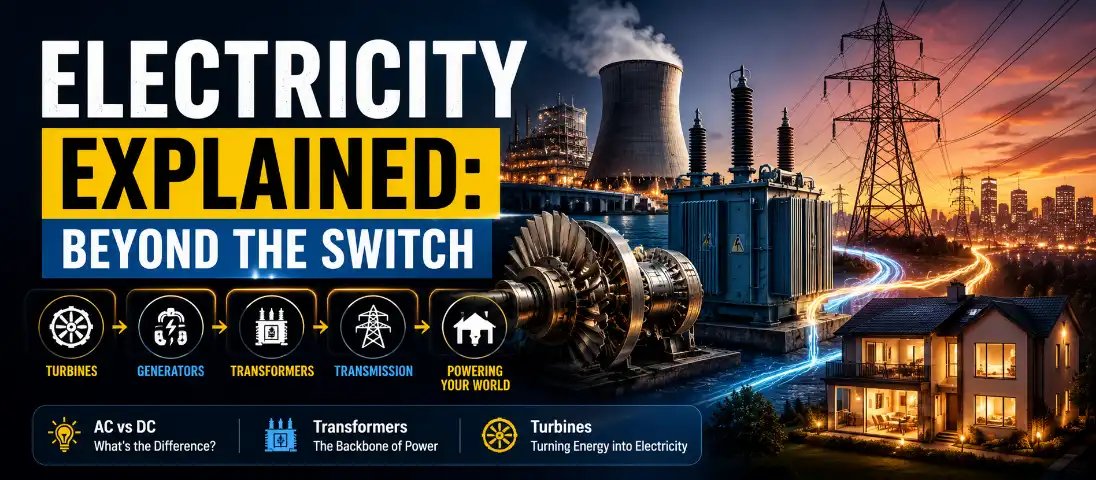
Discover how AC and DC electricity work, why transformers are essential for efficient power transmission, and how turbines generate electricity through electromagnetic induction. A beginner friendly explaination.
This is the 4th blog, go read my previous ones if you haven’t…. Or don’t….
Introduction
*Eating chips* Hi, welcome back to my probably second last blog in this series because well…. This field doesn’t have much to interest many and myself in my opinion… but after this I will be taking a better series… making aircraft! Not exactly, to be accurate it is called aerodynamics and aerospace engineering. Back to topic, in this blog I will be talking about AC and DC which I left as a mystery for y’all and also how turbines work, which allow most of humanity to doomscroll on phones 😐…. So lettuce begin.
AC and DC
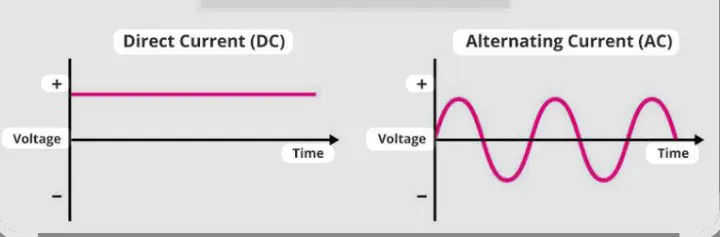
So, as we learnt in the last blog that solar panels generate DC (its full form is direct current) and that DC needs to be converted to AC (its full form is alternating current). Now you may get the direct current part- yeah, current go zoom through wire into phone :) not too complicated. Direct current is just “direct” current. Current is the flow of electric charge, its unit is Ampere.
- Ampere = Charge/second
(Current is the number of charges passing through wire in one second)
You can think of electric charge like a ball carrying electric energy, its unit is coulomb. So now that we got the basics covered, I will properly explain DC. It is the current that flows in one direction, like it should, but you may say “ Isn’t that how current is supposed to flow” well, no, my naive friend. Let me introduce you to AC (not air conditioner), alternating current (AC) is the current whose flow alternates like a dance, I mean the electrons are just vibin’ man. Their movement is like when you like the beat of a song, you may start moving your neck forward and backwards, that is kinda how AC (again.. not air conditioner) moves.
Just like that. But you may say if they move forward and backward, they aren’t going anywhere, I mean you’re right, but you miss the important thing, the balls don’t move, the energy does and the same thing happens in DC, but slightly differently. Consider that the electrons in the wire are tightly packed balls in a tube having electrical energy, so if I pushed a ball at one end, all the balls in the wire wouldn’t come out the other end, but the last one would, and just like in DC the electrons move, but slowly and in one direction and their movement isn’t electricity, but the energy of my push that transferred through all the balls to the other end instantly is. And that is simply DC. In AC (I swear to god, I’m saying this for the final time, it… isn’t AIR CONDITIONER!), instead of balls moving in one direction, they move backwards and forth, not moving themselves much, but effectively transferring the electromagnetic energy forward at the speed of light.
(electromagnetic wave or energy is a non-mechanical wave I.e. that doesn’t require any medium like air or water. In it the electric and magnetic fields oscillate and vibrate to move the wave forward, instead of matter.)
**Yeah I know this sounds a bit complicated, but if anyone has any doubts, just let me know in the comments, I will answer you questions in a separate blog**
Now, for another question, why do we prefer AC over DC? So, for starters, its voltage could easily be changed using transformers (many appliances like your phone charger are transformers).
An electrical transformer is a device that can change the voltage in a current using electromagnetic induction. It consists of a soft iron core with a coil wrapped around one end and another coil on the other end. It has 2 types: step up and step down. Step up increases volts and step down does the opposite. It works on the basis of which side’s coil has more turns, if the input side has less and output has more, the transformer converts low voltage current into high voltage current, which is a step up transformer and as you should have figured out by now, in the step down transformer, the input side has more turns and output has less turns.
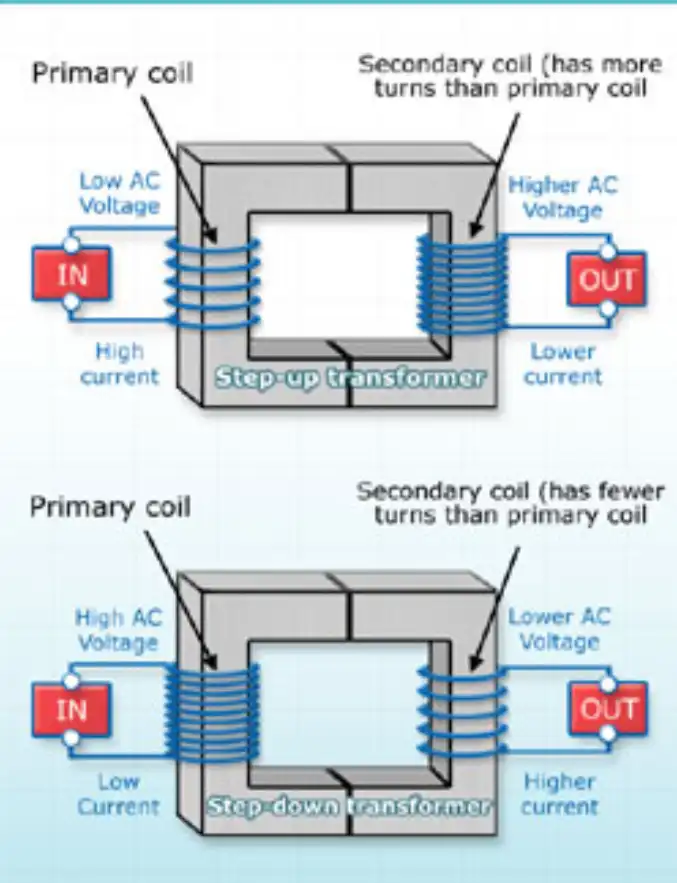
*Electromagnetic induction is just the generation of electricity using magnets and magnetic fields.
When AC flows into a transformer:
- The current keeps changing direction.
- This change in direction creates a magnetic field.
- This magnetic field passes through iron core
- And that changing field creates electric current in the output coil.
I am pretty sure that some of you have played or seen minecraft content. If not then just ignore this part, but if yes then you must know about the observer block, relate this with the observer, it reads block state changes and when a block state is changed, it gives a redstone output signal. Similarly here the magnetic field changes.
Now why do we need to change the voltage at all? Simple answer- resistance. You see…. if all electricity that passes through a wire reached its destination, we would’ve never needed AC. Resistance is just opposition to the current, it generates heat. Resistance is directly dependent to current, but inversely dependent to voltage i.e. if resistance increases voltage drops, as well as current; if voltage increases resistance drops and current increases. So back to the question, in DC we can’t easily change the voltage because transformers don’t work here as current doesn’t change, so either we use high voltage, low current- which can be transmitted efficiently, but is dangerous or we use low voltage, high current- which is safe, but extremely inefficient. So…. as a solution, we got AC!
However, since we don’t live in the 20th century (1900s, yes it is 1900s, if u don’t believe me check on Google), we have modern technology, and that gives us HVDC! HVDC (high voltage direct current) is just DC, but high voltage and its voltage can be efficiently increased or decreased and can have lower losses over longer distances, but then why not replace AC with HVDC? Simple answer… practicality.. AC is just too good…. I mean.. It is simple to generate, easy to convert, and widely used, while HVDC requires complex electronics and is quite expensive. So yeah just stick with AC 👍.
Attack on turbines
Turbines here… turbines there.. turbines everywhere. What are they? A turbine is a machine which converts the motion of a fluid passing through it into rotational motion. A fluid is anything that ‘flows’ like air, water, orange juice and all liquids and gases. The turbines are usually connected to generators that convert that rotational motion into electricity. Turbines work on the principle of electromagnetic induction, which as I have said previously is generation of electricity using a changing magnetic field, it was discovered by Michael Faraday. The simple idea is that when a magnetic field just decides to dance, it disturbs the electrons and forces them to move, creating current… man… magnetic field vibes………..
So yeah a changing magnetic field moves electrons and creates current in a direction. Yep no more complications.
Conclusion
This will be my second last blog or the last I should say…. That is because I am kinda bored of energy series and want to take a more engaging field, aerospace engineering or building rockets and planes. If you have any questions, I will be checking the comments on my blogs. I will be answering those questions in the totally last blog. However, if y’all want, I will continue this series, with better and more advanced content. So may the force be with you….
Keep learning… or stay dumb like cattle because learning is what sets us apart.