How Did Our Solar System Actually Form?
Table of Contents
This blog ain’t a casual space talk, it’s a physics-first breakdown of HOW and WHEN our Solar System formed. It’s clean, easy & precise. So, dive in, challenge your thinking, and see the universe with real clarity.
Every planet, asteroid, and comet in our Solar System began as a microscopic dust drifting in a cold molecular cloud. But how can something this enormous and as structured as the Solar System emerge from some chaotic cloud of gas and dust? Well, you’ve landed at the right place! In this blog, I’ll break down these ideas with full Physics-Driven explanations.
At 4,550 million years of age, our solar system didn’t exist. There was no Sun; no planets. Only a dark, brooding, and utterly frigid cloud in space at temperatures of around -260℃, called the Giant Molecular Cloud.
Giant Molecular Clouds (GMCs)
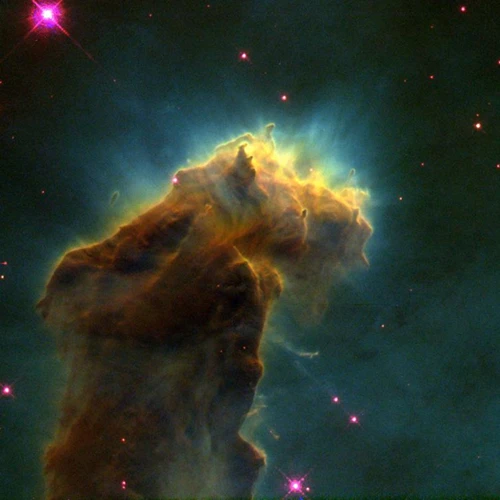
One of the gas pillars in the Eagle Nebula, photographed by the Hubble Space Telescope (NASA/ESA).
A Molecular Cloud, also known as a Stellar Nursery (if star formation is occurring within), is a type of Interstellar Cloud. These clouds are vast, cold, dense, and knotty (with some regions denser than others), enough for gravity to play a dominant role in their evolution.
These clouds are composed overwhelmingly of molecular hydrogen (a gas where hydrogen atoms join together in pairs to form molecules). Molecular Hydrogen, or H2, makes up around 88% of a typical cloud’s mass, with helium and trace gases making up another 11%. Only about 1% of the mass is made up of dust. But but… this is not the household dust we are familiar with. Interstellar Dust is far smaller, usually about ~0.001mm (10^-6 meter) or smaller. And is composed of silicates or rocky substances.
At this point, two fundamental questions arise: why are molecular clouds so dark, and why are they so cold?
Well, molecular clouds are dark because the dust grains within them are comparable in size to the wavelength of light, and as such, are very good at blocking the passage of light. Let me break this down for you:
Basically, visible light has a λ (wavelength) of about 400–700nm, that is 4*10^ -7 to 7*10^ -7 meters, and these numbers are in the same order of magnitude. But why does size matter?
When a particle is:
- much smaller than light’s wavelength → light mostly passes through.
- much larger than light’s wavelength → light can be blocked or reflected.
- about the same size as the light’s wavelength → very strong scattering & absorption occurs.
And Interstellar dust grains fall in the third category. So they absorb visible light, scatter visible light, and prevent it from travelling through the cloud. This process is called Extinction (absorption + scattering).
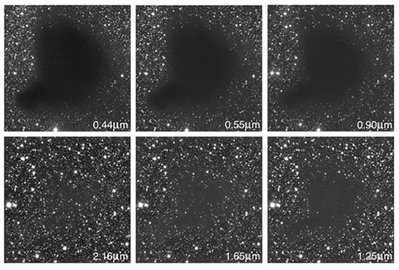
Because of this extinction, background starlight cannot pass through the cloud, making it appear dark. Another reason for them to appear dark is that they are cold (-260℃). Basically, cold objects don’t emit visible light; they mainly emit infrared or radio waves. But why? Look, any object above absolute zero emits electromagnetic radiation. The wavelength of peak emission depends on temperature, which is described by Wien’s Law: 𝜆max = b/T.
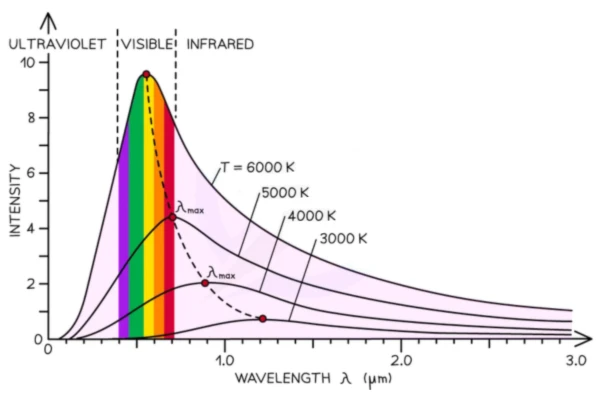
Where 𝜆max:- peak wavelength, T:- temperature in Kelvin, & b:- constant. In molecular clouds, T ≈ 10k, so 𝜆max = 0.3mm → far infrared and in microwave range (not visible light). Therefore, molecular clouds do not emit visible radiation; they glow only at much longer wavelengths.
Now, moving on to the other question: why are they so cold?
As said before, they are usually about 10–30 K (−263 to −243 °C), and the reason comes down to a combination of physics and chemistry. Let’s break it down:
- They are shielded from starlight: we already know molecular clouds are dense and dusty. Their dust absorbs most of the ultraviolet and visible light from nearby stars, which would normally heat up gas. And without this external heating, the cloud can only rely on internal processes, which are weak.
- Efficient cooling mechanism: in these clouds, H2, CO and other trace molecules emit energy very efficiently in the infrared and radio wavelengths. So even if a small amount of energy heats them up, they quickly radiate it away. For example, CO molecules rotate and vibrate, emitting photons that carry energy out of the cloud.
- Low Density: Even though these clouds seem dense compared to the interstellar medium (the matter & energy that exists in the space between stars within a galaxy), they’re still extremely sparse compared to anything on Earth. Fewer collisions between particles mean less internal friction and overall heating.
So yea, these were some of the main reasons why these GMCs are extremely cold.
Gravitational Collapse & Dense Globules
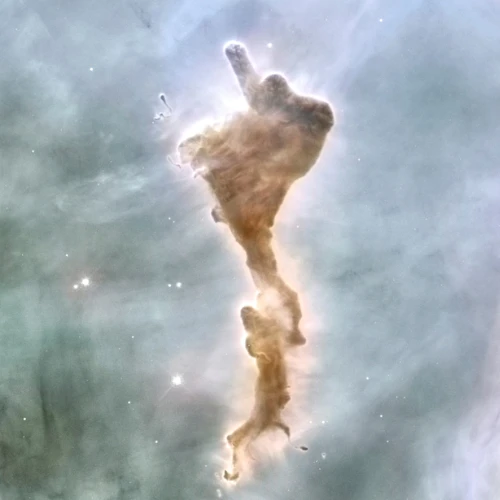
Bok Globule: The Finger of God in the Carina Nebula.
Before we define Bok globules, it’s important to note that not every small dark patch in a molecular cloud is a Bok globule. A molecular cloud contains many clumps of gas and dust, but only the small, dense, and cold pockets that are likely to form stars are called Bok globules. Other clumps may exist, sometimes called dark globules or cometary globules, but they don’t necessarily have the conditions for star formation. So, I’ll be focusing specifically on the Bok globule as this is the region where stars, and eventually planetary systems begin to form.
A Bok Globule (named after Bart Bok, a Dutch-American astronomer who studied them in the 1940s) is a dense, cold region within a molecular cloud where stars begin to form. It is formed naturally within the molecular clouds due to the following phenomena:
1. Instability in a Dense Globule: In a Bok Globule, the tiny movements of gas and dust create a pressure that pushes outward (thermal pressure), while gravity pulls everything inward.
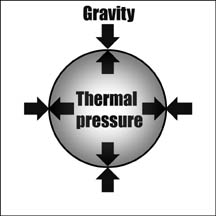
Basically, the internal thermal pressure of a Bok Globule (from particle motion) opposes gravitational pull. If these two forces were perfectly balanced, the globule would just stay as it is. Small fluctuations in density, pressure, or external influences (like shock waves from nearby supernovae or radiation from massive stars) can upset this balance. When gravity starts winning in a certain spot, that part of the globule becomes unstable and begins to collapse. And this instability is the “spark” that triggers collapse.
2. Jeans Collapse: The Jeans criterion is a way to determine whether a region of a molecular cloud, or a Bok globule, will collapse under its own gravity. It said that a region collapses if its mass exceeds the Jeans mass Mj or its size exceeds the Jeans length λJ. Mathematically, the Jeans mass depends on temperature (T) and density (ρ) as follows:
Mj ∝ T^(3/2)/ρ½
- Lower temperature (T↓): The gas particles move more slowly, so thermal pressure is weaker. Gravity has an easier time overcoming it, making collapse more likely.
- Higher density (ρ↑): More mass is concentrated in a region, increasing the gravitational pull. Even if the gas is warm, gravity can dominate if the density is high enough.
The Jeans length is the minimum size a region needs to start collapsing. If a part of a globule is bigger than this, gravity wins over pressure, and that region begins to shrink, eventually forming a protostar (the first stage of a new star).
3. Fragmentation: When a Bok globule collapses, it usually doesn’t shrink as one big, uniform ball. That’s because the cloud isn’t perfectly smooth, it’s turbulent and uneven, with tiny differences in density throughout.
As gravity pulls the globule inward, these small differences get amplified. The denser parts collapse slightly faster than their surroundings, creating separate pockets inside the larger cloud. Each of these pockets can become its own dense core, which may eventually form a protostar.
Formation Of The Solar Nebula
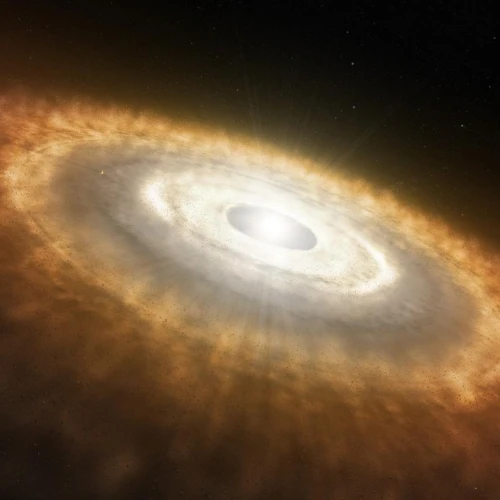
Nearly 5 billion years ago, inside a cocoon like this, the Sun and the planets were forged. Over time, this Solar Globule continued to shrink under its own gravity, and as it shrank, it grew hotter.
But why would shrinking make something hotter? Well, this is because gravitational potential energy is converted into thermal energy. When a cloud contracts under gravity, particles fall inward. And as they fall, their gravitational potential energy decreases, and that energy doesn’t disappear, it converts into kinetic energy. More kinetic energy = particles move faster, & faster particle motion = higher temperature. That’s why it warms!
This heating is governed by the Virial Theorem. It simply says that when a self-gravitating system (like a collapsing cloud) contracts, half of the gravitational energy released goes into heating the gas. So contraction → energy release → temperature rise.
The theorem states: 2K + U = 0
- K = total kinetic energy (motion of particles → temperature)
- U = total gravitational potential energy (negative quantity)
Rearranged: K = –(U/2)
But what does this mean physically? Here, gravitational potential energy U is negative. So, when the cloud contracts, this U becomes more negative (due to stronger gravity binding). And to satisfy the equation K must increase, so, more kinetic energy → particles move faster, & faster motion → higher temperature.
As the Solar Nebula shrank, it spun faster (conservation of angular momentum). It must spin faster to conserve angular momentum. Here’s a breakdown: angular momentum is basically rotational motion that cannot just disappear. For a rotating object, L = Iω.
- L = angular momentum
- I = moment of inertia (depends on how spread out the mass is)
- ω = angular velocity (how fast it spins)
If no external torque (simply a force that makes something rotate) acts, L stays constant.
Now let’s apply this to our Solar Nebula. It was huge, diffuse & slowly rotating. As gravity pulled it inward, its radius decreased, its mass became more centrally concentrated, and its moment of inertia I decreased. And since angular momentum must stay constant, so if I↓, then ω↑. So it spins faster, as simple as that :)
Now that our solar nebula spun faster and faster, it flattened out. After 100,000 more years, the globule was transformed. In its place was a flattened, rotating disk of gas and dust known as the Solar Nebula.
Birth of a Protostar & Sun
In the hot central region of the solar nebula was a glowing mass, bigger than the present orbit of Mercury, called a Protostar. And then, millions of years later, with continued contraction and warming, the protostar formed the Sun. Let’s see in detail, using physics, what actually happened.
So basically, as material continued to fall toward the center, pressure and temperature increased dramatically (~10 million K). Eventually, the core grew hot enough for hydrogen nuclei to fuse into helium. When nuclear fusion began, gravity was finally balanced by outward pressure. The protostar had become the Sun.
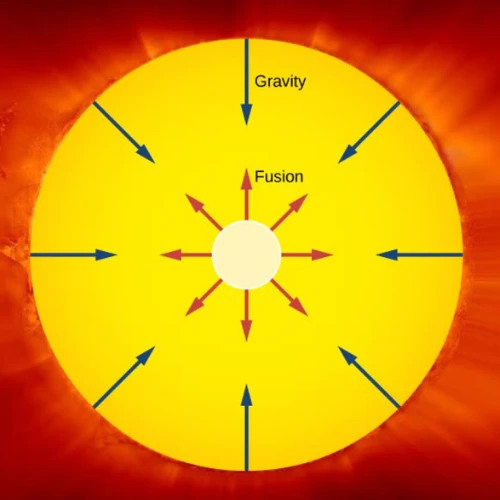
- Nuclear fusion happens when light nuclei join together to form a heavier one, releasing enormous energy. In the early Sun, hydrogen nuclei fused into helium, generating the energy that powers our star. Inside the young Sun, the core temperature reached about 10 million Kelvin. At that temperature, hydrogen atoms move extremely fast, and they collide so forcefully that they overcome their electrical repulsion. The energy is released as heat and light. That energy is what makes the Sun shine!
- Hydrostatic Equilibrium: Once fusion began, the outward pressure from the energy it produced balanced the inward pull of gravity. This balance, known as hydrostatic equilibrium, stabilized the Sun and prevented it from collapsing further.
From Dust To Planetesimals
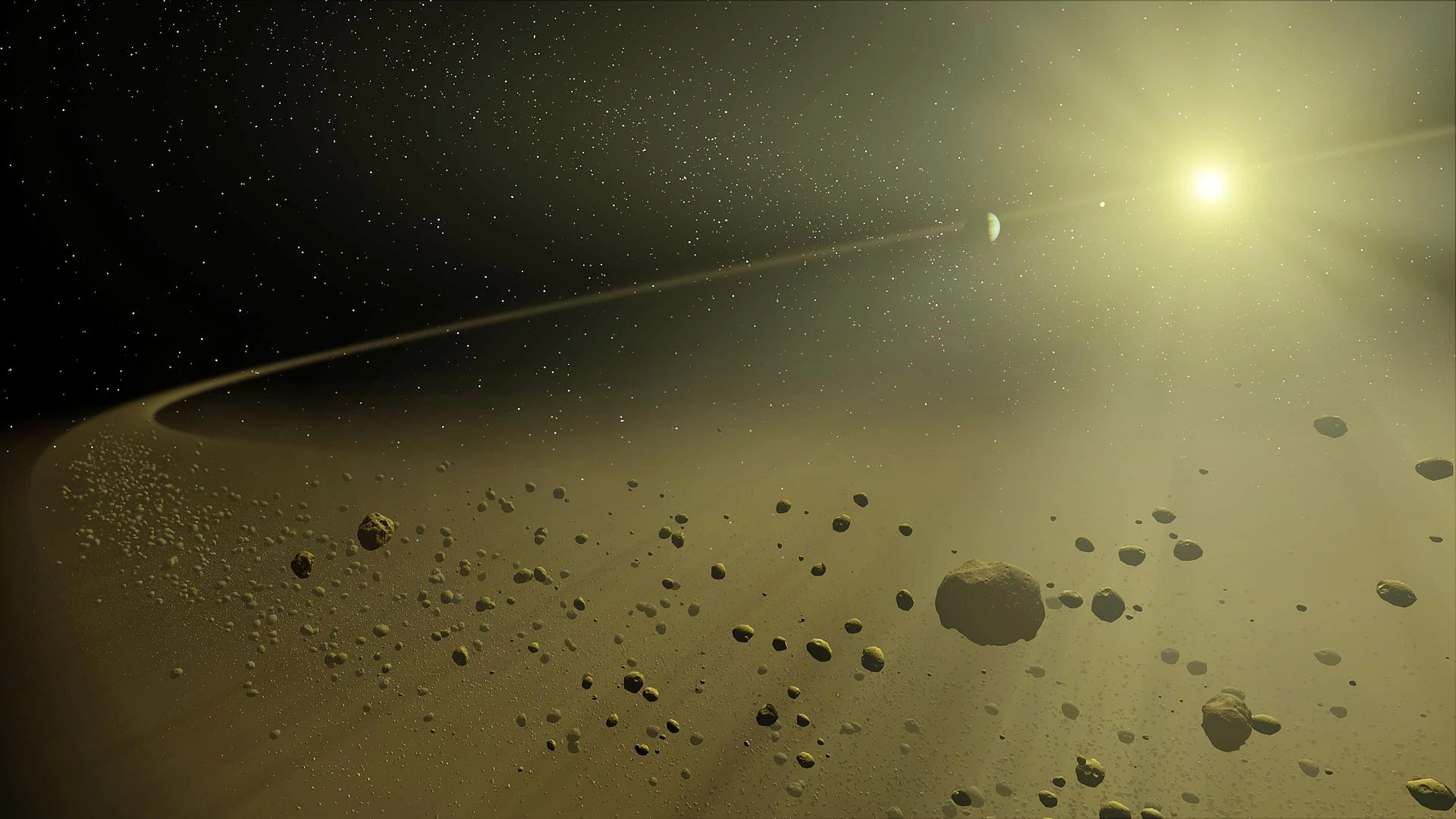
Meanwhile, within the surrounding disk, tiny dust particles began sticking together due to electrostatic forces. Over time, these particles grew into pebbles, then rocks, and eventually larger boulders. As collisions continued, these boulders merged and expanded into mountain-sized planetary building blocks known as Planetesimals.
The collision rate increased because the objects were no longer just drifting into each other by chance; they were actively pulling one another together through gravity. And after a few more million years, most planetesimals were gradually incorporated into larger bodies, forming the eight major planets. The remaining fragments persisted as asteroids (debris from the formation of the Solar System that survives to this day!)
Conclusion
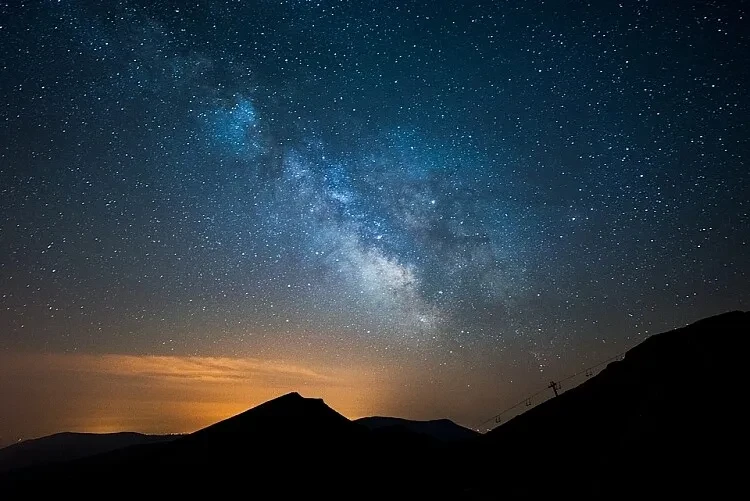
The next time we look at the night sky, it is worth remembering that our Solar System began as an unremarkable cloud of gas and dust. Through gravity and time, that cloud transformed into stars and worlds. In understanding its origin, we better understand our own place in the universe.
Thanks for reading! If you enjoyed this exploration, feel free to share your thoughts or questions below.