How Did The First Stars Formed?
- Yamin Shaban
- Cosmology
- July 4, 2026
Table of Contents
Journey back to the dawn of the Universe and discover how the first stars were born, why they shine, and how they transformed endless darkness into a cosmos filled with light, explained in simple, fascinating, beginner-friendly language for everyone today.
Introduction
The Stars are beautiful, aren’t they. Shinning in the nights and looks small but this is our big mistake to provoke them, they aren’t small rather so big that only distance makes them small. But have you ever wondered what is the process of the formation of these giant bodies? What are they composed of? Why are these Stars so big? I bet that you had these questions and today we are going to look into the formation of these stars rather the formation of the very first stars of the Universe. So let’s begin…
What is a Star Actually?
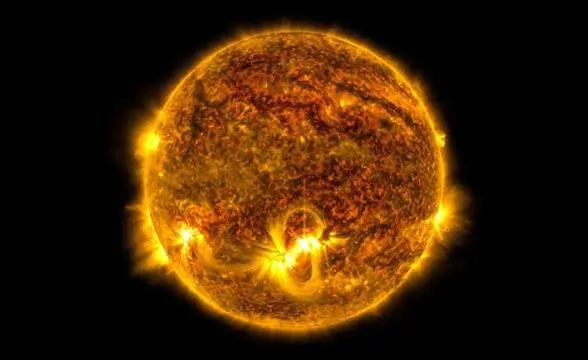
A star is a gigantic, glowing ball of extremely hot gas. It is made mostly of hydrogen and helium. Unlike planets, stars produce their own light and heat. They do this through a process called nuclear fusion, in which hydrogen atoms combine to form helium and release a tremendous amount of energy. Our Sun is one such star.
The Formation of The First Star
After the formation of atoms, the light moved freely in the space over the large cosmic distances. However, this affected the Universe in such a way that there no light during this period and this period is called as the dark ages. Imagine that the whole universe was dark and quit, no sign of light. Then the first Stars came into the action and these Stars made our Universe visible.
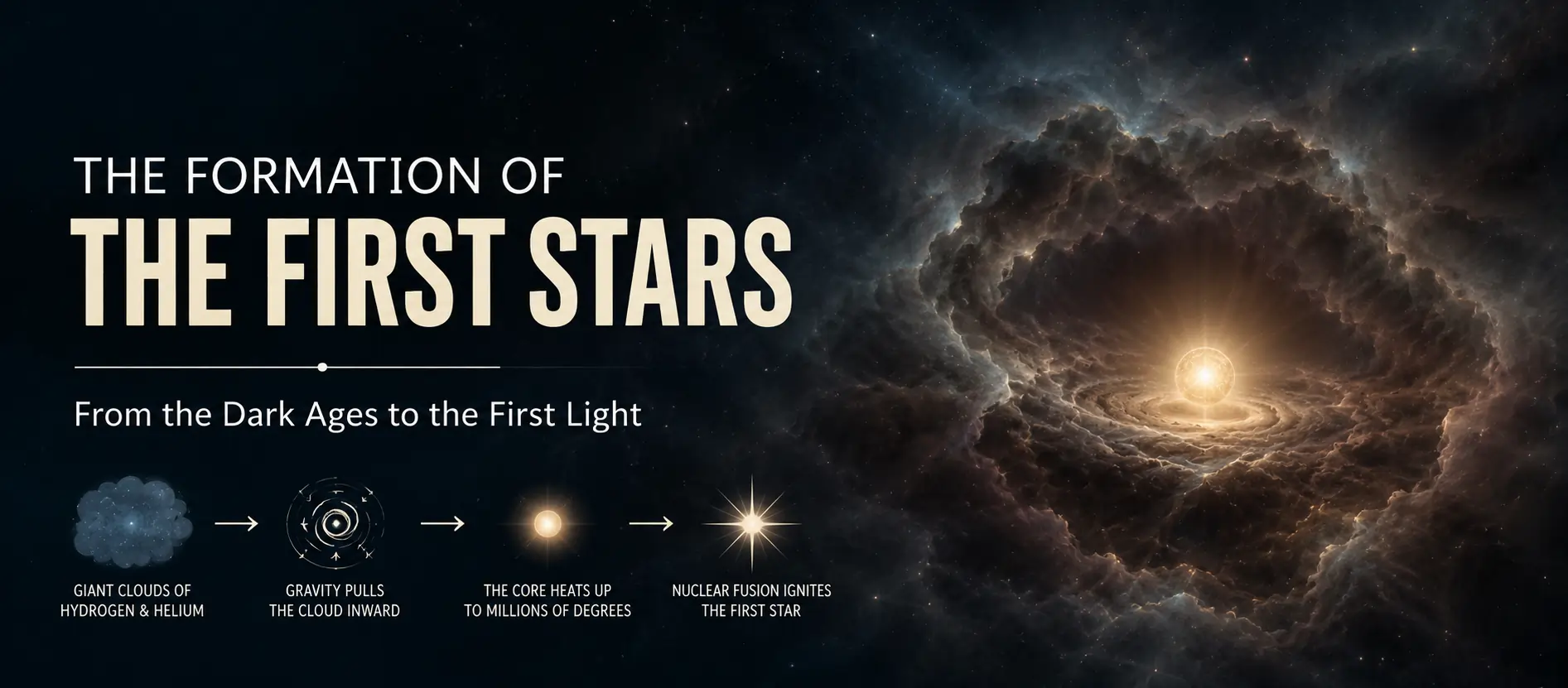
**During the Dark Ages, there were no stars, no galaxies, and no planets. Space was filled only with enormous clouds of hydrogen and helium gas.(Hydrogen and helium gases were formed in large amount before the dark ages the protons and neutrons were sticking together).**At first, these gas clouds were spread out over vast distances. However, they were not perfectly uniform. Some regions contained slightly more gas than others.
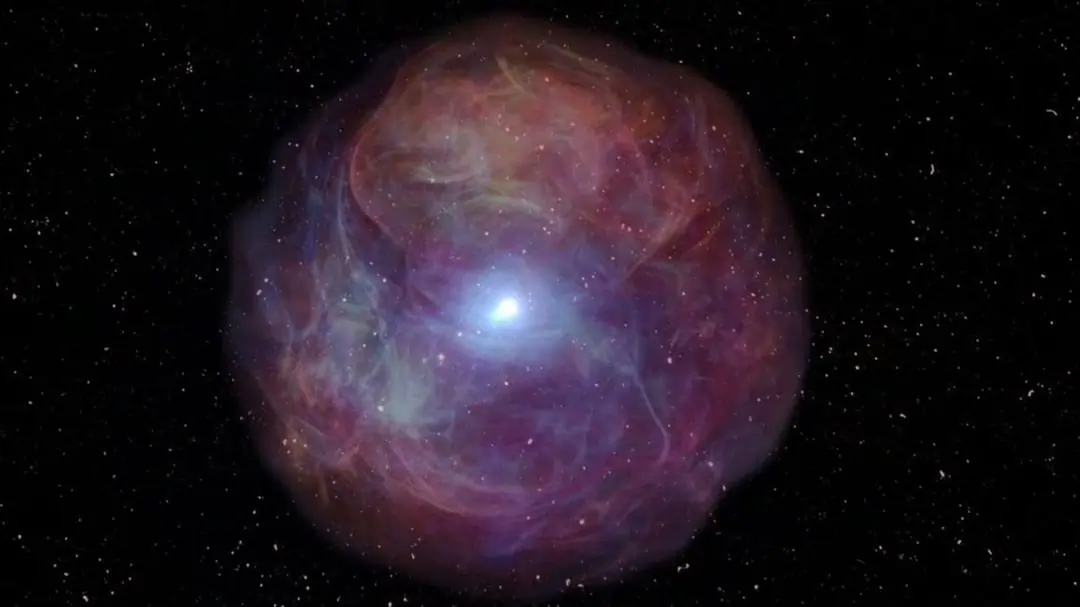
Because these regions had a little more matter, their gravity was slightly stronger.It slowly attracted more and more gas from the surrounding space. As this continued over millions of years, the cloud became larger, denser, and heavier.
Gravity Started to Dominate
As gravity kept pulling the gas inward, the cloud began to shrink. The gas particles were squeezed closer and closer together. Since the particles had less room to move, they collided with each other more often. Every collision converted a little of their motion into heat, making the centre of the cloud hotter and hotter.
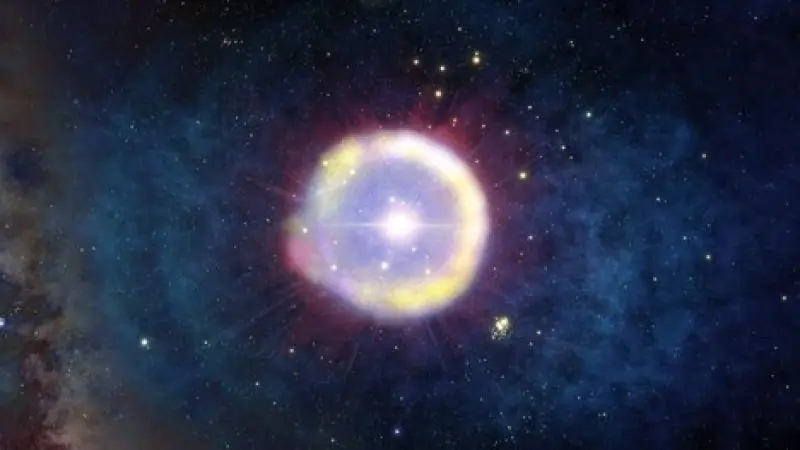
The collapse continued until the core reached an incredible temperature of about 10 million degrees Celsius. At such a high temperature, hydrogen atoms were moving so fast that they could overcome the force pushing them apart. They began to join together, forming helium atoms. This process is called nuclear fusion.
Nuclear fusion released an enormous amount of energy in the form of light and heat. This energy pushed outward while gravity continued pulling inward. Eventually, these two forces balanced each other. The cloud stopped collapsing and became stable.
At that very moment, the first star was born.
Nebula
The first Stars formed when hydrogen and helium gases mixed together via gravity but todays Stars form inside a Nebula. A Nebula is simply a large dust cloud comprising of gases in the space. So what’s the difference? The difference is that the Nebula doesn’t only contain the helium and hydrogen gases rather it contains these gases as well as other heavier elements like Carbon, Nitrogen, Iron, silicon etc. The Nebula is not something random rather it’s well organized cloud where the most of the Stars form today. The formation of the first stars took place under difficult situations because there were only the two gases (hydrogen and helium) and these gases do not cool down easily, they take good amount of time and this became a resistance for gravity making it harder for gases to collapse into Stars.
Conclusion
This blog focused on explaining the formation of first stars simply. I really hope that you understood this blog well. Soon we will be heading towards the most mysterious region of the Space so far we know. The region where our laws fail. I think you found that, if not then stay connected for that blog, Bye.