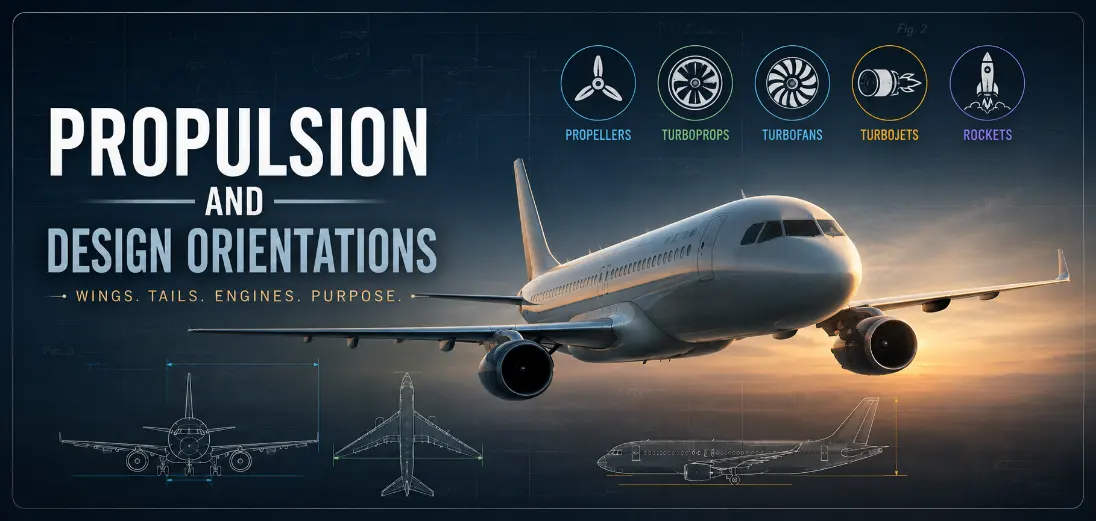
Propulsion and Design Orientations
- Sikander Manzoor
- Physics
- August 4, 2026
Table of Contents
What actually pushes an aircraft forward? From spinning propellers to powerful jet engines and rockets, discover how different propulsion systems use the same laws of physics to generate thrust and make flight possible.
*This is the the 5th blog, READ the previous blogs or I will have nothing to FEED myself.
Introduction
Habibi welkam tu blog! Hoping that everything is good! As is with me.. as you know that we were planning on bom- engineering a plane. In this blog we will get to know why engines, wings and tails are placed the way they are. let’s just get on with the blog before my muslim instincts kick in… So, lettuce begin.
Wings and Tails
If you’ve ever looked at different aircraft, you’ve probably noticed something interesting and interesting fact that not all aircraft look the same.
Some have their wings mounted on top of the fuselage (if you would remember, the fuselage is the main body of the plane which carries all the stuff aka payload), some in the middle, and others near the bottom. Some have long, slender wings, while others have short, swept-back wings. Some have a large tail, while others seem to have barely any at all.
At first glance, it may seem like aircraft designers simply choose whichever design looks the coolest. Fortunately for the passengers, they don’t. Every part of an aircraft is placed where it is for a reason. Just as you wouldn’t build a house by randomly placing doors and windows wherever they fit, aircraft engineers don’t randomly attach wings and tails. Every design is a compromise between stability, performance, efficiency, visibility, strength, and the mission the aircraft is expected to perform.
Let’s start with the wings…
Wing orientations
The wing is responsible for generating lift, but where it is attached to the aircraft is just as important as the lift it produces.
Most aircraft have their wings located close to the aircraft’s center of gravity (the center of gravity is a position on the plane where most of the mass is or where gravity acts the most). This keeps the aircraft balanced and prevents unnecessary pitching moments during flight. If the wings were placed too far forward or too far backward, controlling the aircraft would become much more difficult.
Think of carrying a heavy backpack. If the weight is close to your body, walking feels comfortable. If the same backpack is hanging a meter behind you, you’ll constantly feel like you’re about to fall over. Aircraft experience something similar. Of course, there isn’t a perfect wing position. Different aircraft have different jobs, so engineers choose different configurations, depending on the job.
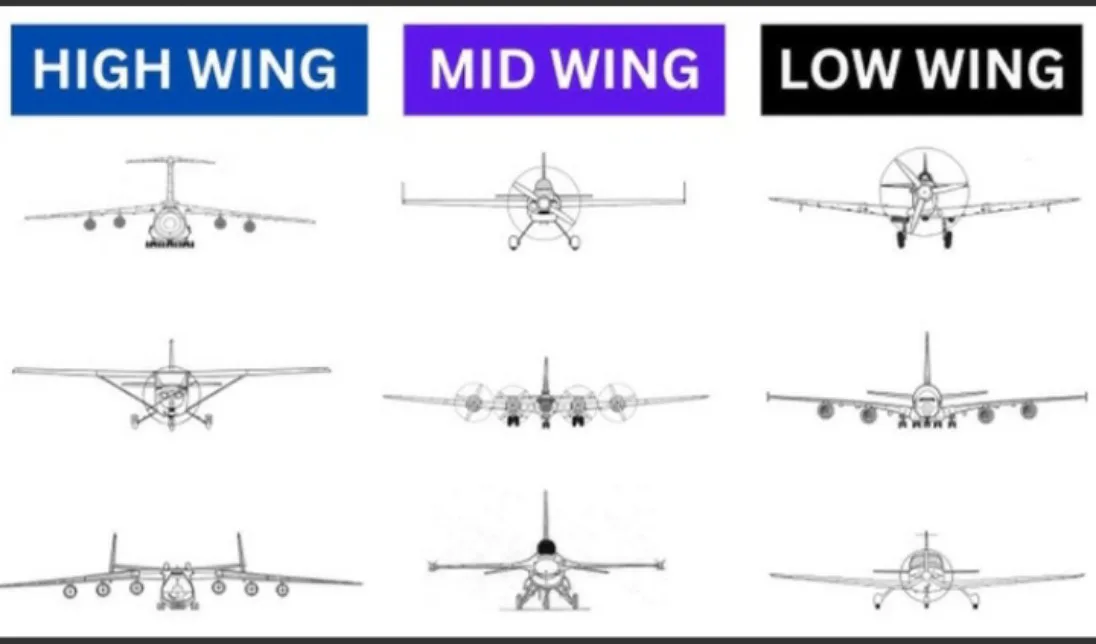
High wing: In a high-wing aircraft, the wings are mounted on the upper side of the fuselage. This design offers several advantages:
The wings naturally provide good stability, making high-wing aircraft easier to fly, especially at lower speeds. Since the wings are higher off the ground, they also provide excellent ground clearance for engines and propellers, which is useful when operating from rough or unpaved runways. Ground clearance is just the distance from the lowest part of the plane and the ground.
Another advantage is visibility. Since the wings are above the passengers and pilots, they can enjoy a much better view of the ground below. This is one reason sightseeing aircraft and many bush planes use high-wing designs. Cargo aircraft also commonly use this configuration because it leaves the lower fuselage unobstructed, making loading and unloading much easier.
Mid-wing: As the name suggests, mid-wing aircraft have their wings attached roughly through the middle of the fuselage. This arrangement provides a very balanced aerodynamic design. The airflow over the wings is generally cleaner because the fuselage interferes with it less.
For this reason, many fighter aircraft use mid-wing configurations. They are designed for speed, agility, and maneuverability rather than passenger comfort or cargo space.
The downside is that fitting a large wing through the middle of the fuselage leaves less room inside for passengers, cargo, or fuel. This makes mid-wing designs less practical for most commercial aircraft like cargo planes and airliners.
Low wing: Low-wing aircraft have their wings attached near the bottom of the fuselage. This is probably the configuration you’ll see most often on modern passenger aircraft. One reason is structural efficiency. The wing can support the heavy landing gear and, in many cases, large jet engines mounted beneath it.
Low-wing aircraft are also easier to inspect and maintain because the wings are closer to the ground. Mechanics generally appreciate not having to bring a ladder just to check every component.
Tail orientations
Imagine moving the tail to the middle of the aircraft or even to the front. It would certainly be a sight worth seeing.. Unfortunately, it would also make it much harder to control.
The tail is placed at the rear because it acts much like the feathers on an arrow. Those feathers don’t make the arrow move forward—they simply help it remain stable and point in the right direction. Being farther away from the aircraft’s center of gravity gives the tail greater leverage. This means it can produce the same stabilizing effect with much smaller forces than if it were located closer to the center of the aircraft. This is due a thing called torque, basically when you rotate something, the farther you are from the axis of rotation, the better it rotates. E.g. a door, go push your door extremely close to the hinge, you will see that it requires more force, but if you rotate it at the other end of the door, it requires less force. Here the hinge is the axis of rotation. Something similar happens in aircraft.
This improves both stability and control while keeping the aircraft lighter and more efficient.
The horizontal stabilizer helps keep the aircraft balanced in pitch, preventing the nose from constantly moving up and down. The vertical stabilizer helps keep the aircraft pointed in the intended direction and resists unwanted yawing motions. Without these stabilizing surfaces, flying would become far more difficult. Every gust of wind would require continuous corrections from the pilot, making even a routine flight exhausting.
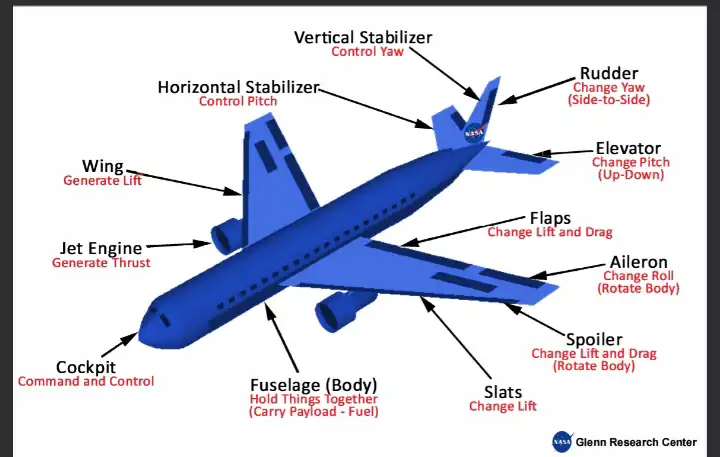
So while the engines may get most of the attention and the wings generate the lift, the tail quietly performs one of the most important jobs on the aircraft: keeping everything stable.
Like the referee in a football match, you rarely notice it when it’s doing its job well—but you’d certainly notice if it disappeared.
Propulsion
An aircraft can have the perfect wings, the perfect tail, and the most aerodynamic shape imaginable. It still won’t go anywhere unless something pushes it forward. That “something” is called propulsion.
Propulsion is simply the method an aircraft uses to generate thrust, the forward force that overcomes drag and keeps air flowing over the wings. Remember from our previous blogs that wings only produce lift when air moves over them. Without propulsion, most powered aircraft would eventually slow down, lose lift, and descend. Different aircraft have different missions. A small trainer doesn’t need the same engine as a fighter jet, and an airliner doesn’t need the same propulsion system as a rocket. Engineers don’t ask, “Which engine is the most powerful?” They ask, “Which engine is the right tool for this job?” Or in simple words you don’t just want “engine go brrrrrr”, instead you will have to design the aircraft according to what the goal is.
Let’s look at the some common propulsion systems:
Propeller
When people hear the word “engine,” they often imagine the noisy spinning propeller at the front of a small aircraft. Actually, the propeller isn’t actually the engine.
The engine is what provides the power, while the propeller converts that power into thrust.
A useful way to think about a propeller is as a rotating wing. Just like a wing generates lift by interacting with the air, each propeller blade is shaped to push air backward in something like a spiral According to Newton’s Third Law, if the propeller pushes air backward, the air pushes the aircraft forward. Propellers are simple, reliable, and highly efficient at lower speeds, which is why they are commonly found on training aircraft, bush planes, agricultural aircraft, and many general aviation airplanes. Simply the casual aircraft.
Turboprop
In the simplest of language turboprop is just:
Fancy propeller
So the only difference is that instead of a piston engine spinning the propeller ( an engine that uses pistons, which are mechanical parts that push things), it uses a gas turbine. This gives it the efficiency of a propeller, but much more power. They are widely used on regional airliners, military transport aircraft, and aircraft that frequently operate from short runways. So.. If you have ever boarded a regional aircraft with large spinning propellers, chances are it was powered by turboprop engines.
Turbojet engines
When most people imagine a fighter jet, they think of a long cylindrical engine with a fiery exhaust and they are right to because that is the classic turbojet.
Instead of turning a large propeller, a turbojet accelerates huge amounts of hot gases out of the back of the engine at very high speed. Those gases rushing backward produce the forward thrust that moves the aircraft. It is just smol fan, pushing hot-hot air. But more complex.
Turbojets perform well at high speeds, which made them popular in early jet fighters and some of the first commercial jet aircraft.
Turbofan engines
This engine is just-
Turbojet + propeller
-at this point. So if you’ve ever looked out of the window of a modern airliner, you’ve almost certainly seen a turbofan engine. A turbofan is similar to a turbojet, but it has a large fan at the front that moves a tremendous amount of air around the engine.
This design produces more thrust while using less fuel and generating less noise. For commercial aviation, that’s an excellent combination.
Modern passenger aircraft rely on turbofan engines because they offer the efficiency needed to carry hundreds of passengers across continents while keeping fuel consumption and operating costs under control.
Rocket Engines
Now this one might not be what y’all expected, but we are doing aerospace engineering and it also has astronautical engineering. So why not give a small idea. Rocket engines are unique because they don’t rely on the surrounding air. Propellers and jet engines need the atmosphere to work effectively. Rockets don’t. Instead, they carry both their fuel and the oxygen needed to burn it. This allows them to operate even in the vacuum of space, where there is no air at all.
The trade-off is that rocket engines consume enormous amounts of fuel in a very short time. That’s perfectly acceptable when your goal is escaping Earth’s gravity. It’s far less practical for a routine flight from Delhi to Mumbai. However the astronautical mission need careful planning and experienced crew or if it is unmanned, a lot of calculations because….. It isn’t exactly that affordable.
Why are engines mounted in different positions?
You may have seen that not every aircraft places its engines in the same location. Some have engines mounted beneath the wings. Others place them on the rear fuselage. Some military aircraft even have engines built into the body of the aircraft itself. This isn’t done for appearance. Engine placement affects an aircraft’s balance, aerodynamics, maintenance, noise, and even the type of airports it can use. E.g. *Large airliners often mount their engines beneath the wings because this arrangement is structurally efficient and makes maintenance easier. *Business jets frequently mount their engines near the rear fuselage, reducing cabin noise and allowing the wings to remain aerodynamically clean. Fighter aircraft often integrate their engines into the fuselage to reduce drag and improve high-speed performance.
And once again there is no universally best design.
Every aircraft is built around its mission:
- A glider prioritizes efficiency.
- A cargo aircraft prioritizes practicality.
- A fighter prioritizes speed and maneuverability.
- An airliner prioritizes carrying hundreds of passengers safely and economically.
Good engineering is rarely about finding one perfect solution. It’s about finding the best solution for a particular problem. It includes finding what you need and what your mission needs, along with proper accounting of resources. But hey! Even if safety isn’t a part of your mission, it isn’t something you can compromise entirely.
Conclusion
I am sure that you might have noticed that our blog schedule was delayed for a while, well it was summer vacation and we decided to y’know take a break. So in the next blog we will be talking about how these engines like propellers, rocket engines work. I hope….
If you got the right mindset for the right job. Don’t worry about failing in it, because you won’t
-read T&S at notawebsite.com, excluding taxes