The Copernican Revolution: Part 1
Table of Contents
Discover how the Copernican Revolution transformed humanity’s view of the cosmos, shifting from an Earth-centered universe to a heliocentric model, igniting scientific inquiry, challenging authority, and laying the foundation for modern astronomy.
The current structure of our solar system seems quite clear and well understood today. Well, it wasn’t like this always… This detailed understanding is the result of centuries of observation, questioning, analysis and study. Um.. naturally a few questions might come to mind like: how did we arrive at this understanding of our solar system? Who were the people behind it? When did it happen? and What exactly is this “Copernican revolution”?
So.. let’s buckle up, and take a ride through this journey of discovery.. les go!
The Geocentric Model
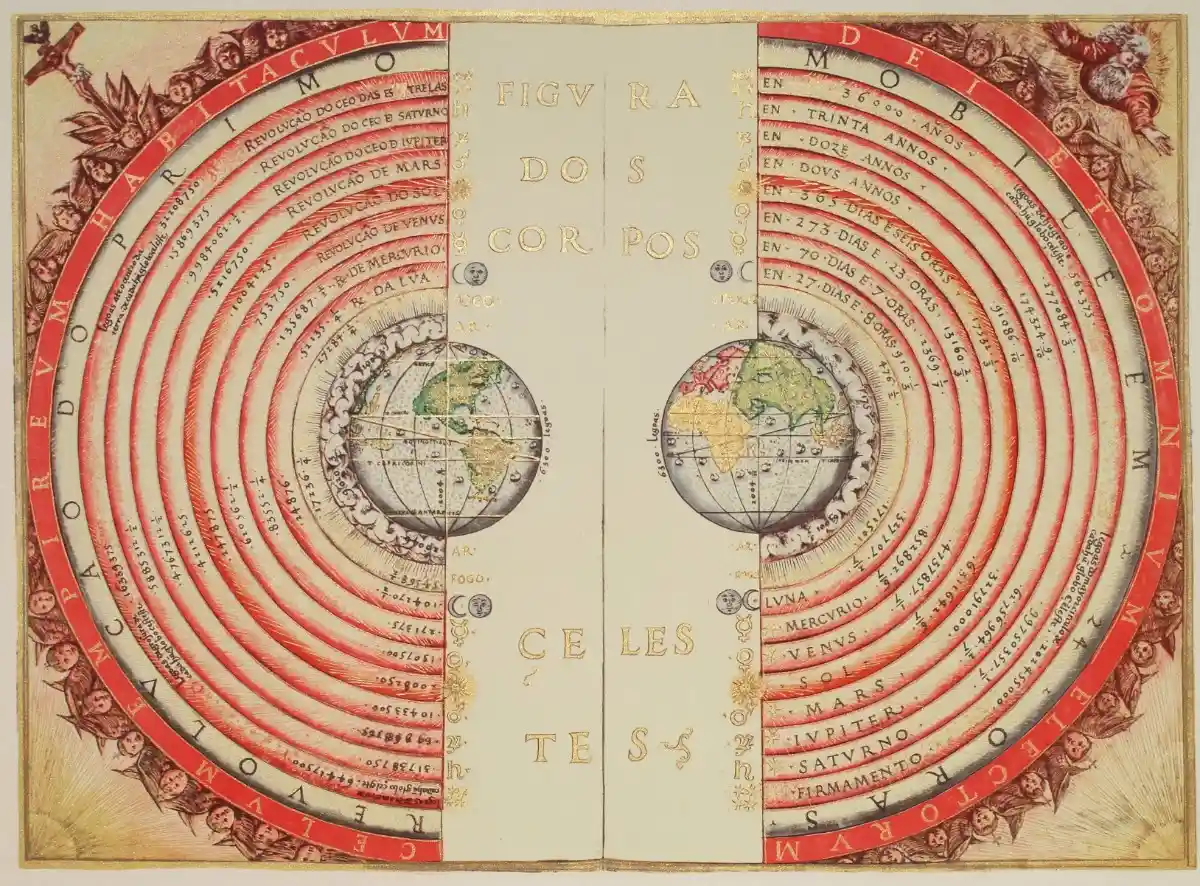
The Ancient Greek philosopher Aristotle believed that the Earth was at the center of the universe, and all the bodies in the sky orbited the earth in eternal circles with perfect motion. This is known as the Geocentric Theory, as opposed to the heliocentric theory which places the sun at the center.
Actually, Aristotle was held in deep regard and so his model was accepted quickly without much doubt or questioning. But, the idea of “perfect circles” seemed to be flawed. What was observed that some planets (especially mars), seemed to briefly switch into retrograde orbits (as if they were temporarily doubling back upon themselves).
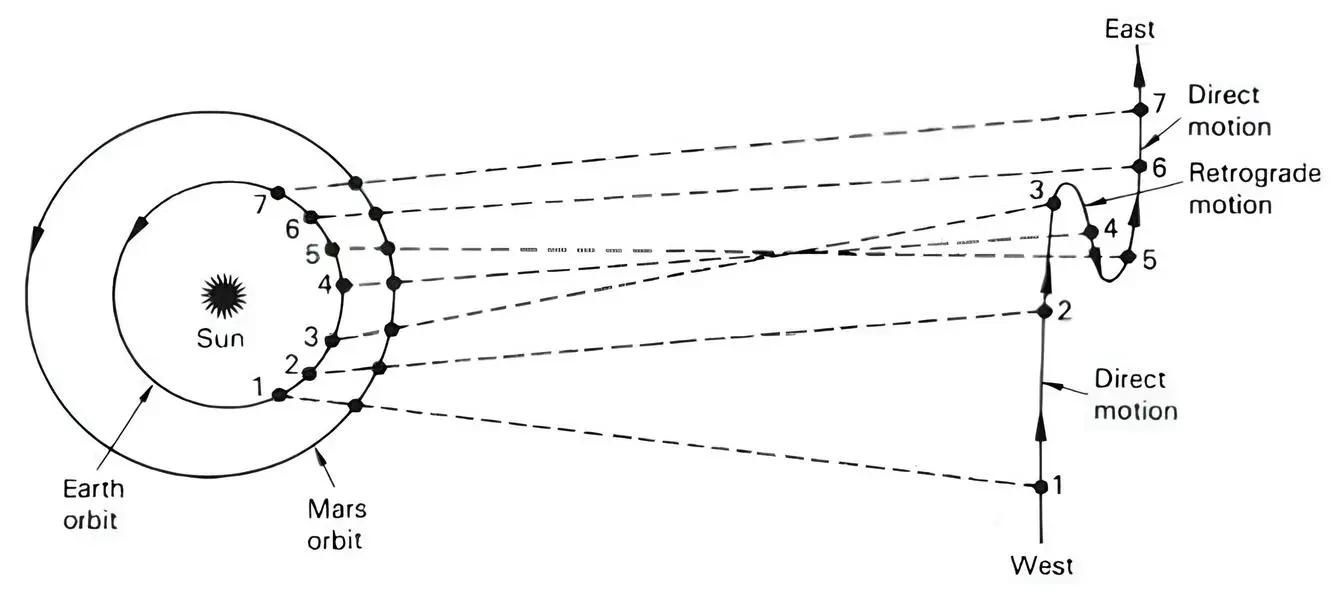
This motion actually isn’t mars reversing its direction, but rather how it appeared from earth because earth moving in a faster orbit, overtakes mars and creates the illusion that mars is briefly looping back in the sky. But but.. this strange retrograde motion created serious problem for the idea that everything in the universe moved in perfect circles (as said by Aristotle) because mars didn’t follow a smooth, perfect circle, instead slowing down, looping backward and then moving forward again. It overall didn’t fit the idea.
Also, the brightness of the planets appeared to vary as they orbited the earth. And this all seemed to contradict aristotle, so Greek philosophers set out to reconcile his theory with these anomalies.
An answer was proposed by Claudius Ptolemy, which was held as truth for centuries. He continued to support a geocentric system, arguing that the varying brightness and the brief retrograde rotations were a result of epicycles. He claimed that the planets themselves do not orbit the earth, instead they follow an epicycle (a circular pathway or more like a mini orbit) on the plane of a much larger circular orbit of the earth.
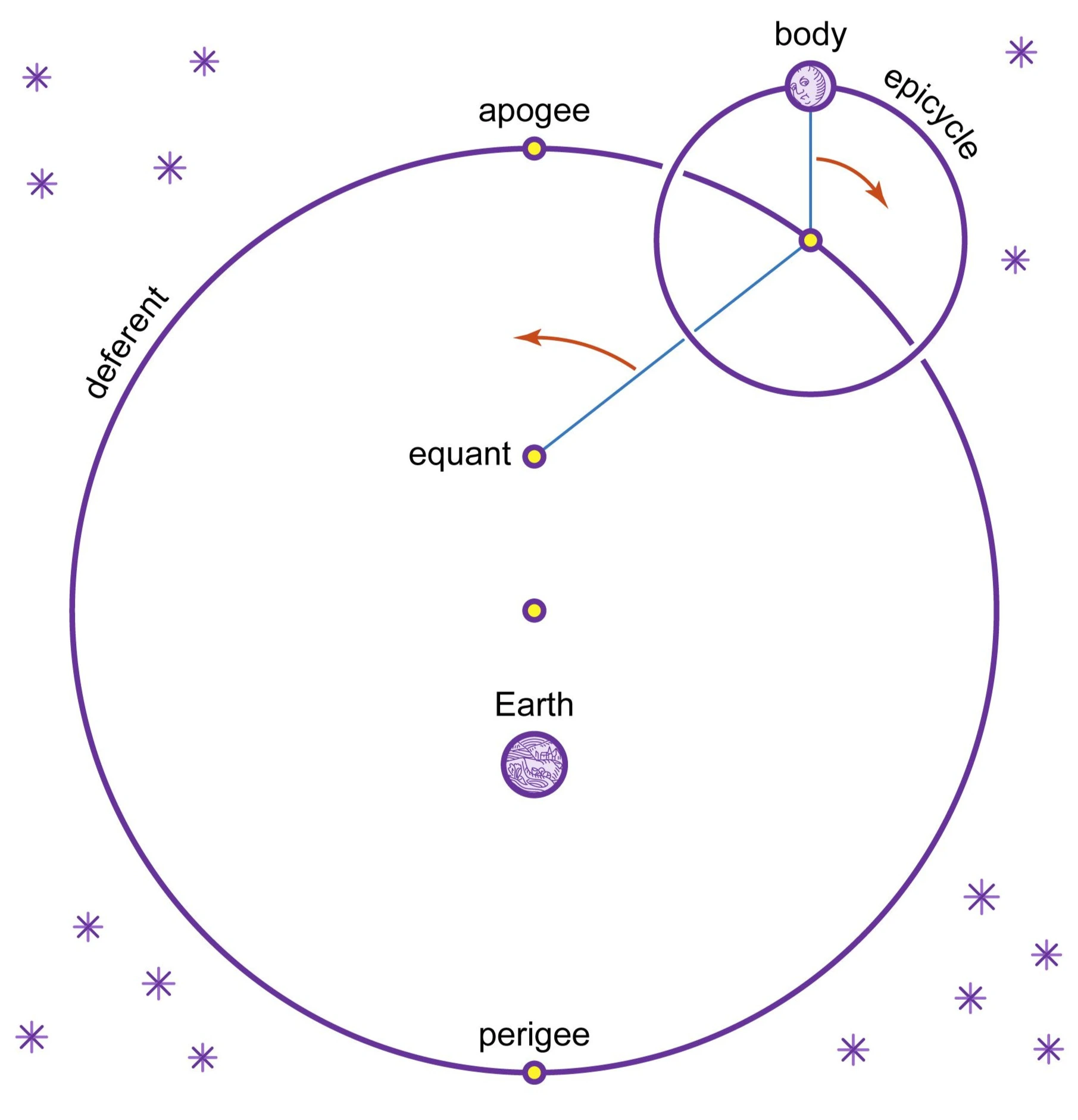
The belief in Ptolemaic System continued for a long period of time because Greek texts were translated into Arabic and became highly influential in the Islamic world toward the end of the first millennium AD. And during this period, the Islamic empire played a crucial role in preserving and advancing astronomy. But most of the work by Islamic astronomers was still built on the underlying assumption that Earth lay at the center of the universe.
Also, in the western europe it went largely unchallenged because it aligned with the religious beliefs of the Catholic Church (it was a dominant religious authority in Europe, with major influence over knowledge and society during that period). In fact, geocentrism also suited most people because it placed Earth, and therefore humanity, at the center of the universe.. making humans seem like a special and important part of creation :)
The Heliocentric Model
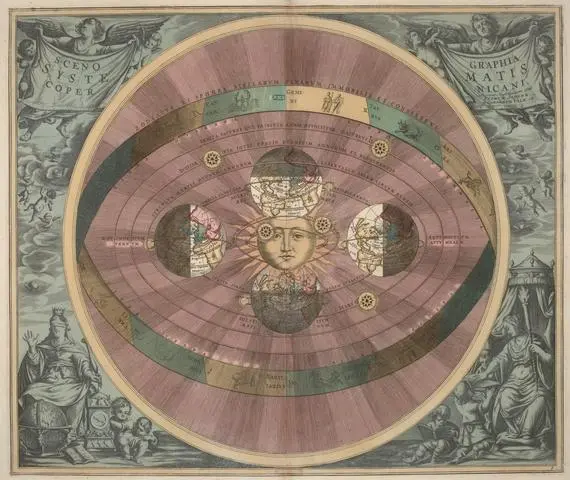
While there the idea of geocentrism continued to dominate for a long time, the supporters of sun-centered system had existed since the time of ancient greeks.
After the death of Aristotle, Aristarchus proposed a heliocentric model of the universe, but it wasn’t popular among greeks. And so during the middle ages in western europe, geocentrism was supported by the church and had become sacrosanct.
The Copernican Revolution
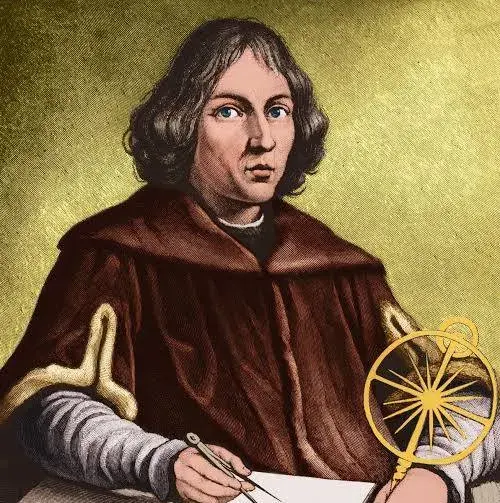
Born in the Polish town of Torun in 1473 just as the middle ages were giving way to Renaissance era (period of “rebirth” in Europe when people rediscovered knowledge, questioned old ideas, and made major advances in science, art and philosophy).
Copernicus argued that Ptolemaic system didn’t properly fit for what he observed in the heavens(outer space). For him the reality seemed far more complicated.
And many of the problems faced by the Ptolemaic model could simply be overcame by placing sun in the center rather then the earth, at the of the known universe. For instance, the retrograde motion of mars can be explained as an optical illusion caused by the fact that earth orbits the sun faster than mars, and so from earth it appears to double back on itself (as already explained).
Copernicus also became the first to realise the true order of the planets in the solar system, earth was demoted from the center to the 3rd rock from the sun. He published his book De Revolutionibus Orbium Coelestium, that consisted of his findings, in the year 1543, the year of his death. Although he had come to his heliocentric conclusion many years before.
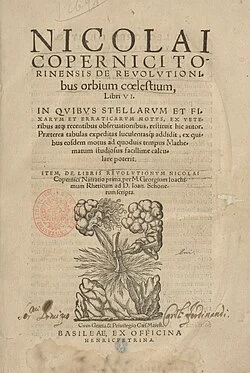
Well, although the church believed in geocentrism, but they were not much bothered by such heresy. Copernicus died before he could be challenged and moreover, he had claimed that the planets orbited sun in perfect circles. But the observational evidence suggested that this wasn’t the case.
The Entry of Tycho Brahe & The Compromise Model
There was a major problem that Copernicus couldn’t prove his heliocentric model to the world with proper and strong evidence. Before Tycho Brahe, models about solar system were based on speculation not precision. In other words, astronomy relied on imperfect and inherited data. Tycho introduced precison by:
i) Building the most accurate pre-telescope instruments. ii) Measuring planetary positions with unprecedented precision. iii) Creating the 1st high quality astronomical database.
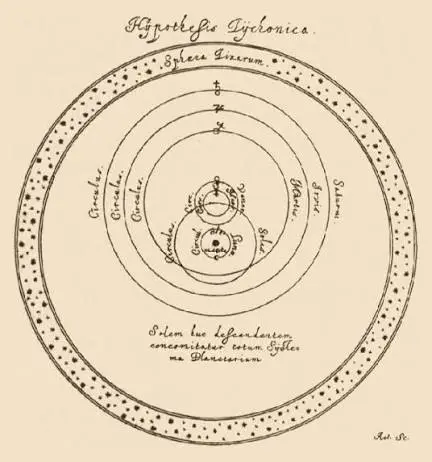
He overall destroyed the old mechanical universe based on rigid spheres. His data didn’t fit perfect circles, he showed planetary motion ain’t perfectly circular. This exposed the failure of both Ptolemaic + Copernican circular orbits. So.. he proposed a compromise model (“compromise” because it mixed earth-centered and sun-centered ideas in one model) or the Tycho’s System.
In his model, he mentioned that earth is fixed at the center, sun orbits the earth and other planets orbit the sun (geo-heliocentric model). This model was incorrect, but it matched observations better than the older ones. He just showed that observational accuracy matters more than a clear explanation and this model was accepted by people for a long time!
His precise data (especially of mars), was inherited by Johannes Kepler, which helped kepler in formulating the Laws of Planetary Motion.
Well, tycho didn’t define gravity, but proved planetary motion follows exact mathematical pattern and eliminated artificials mechanisms (spheres, epicycles).
In 1601, we witness the death of Tycho Brahe…. but some major breakthroughs were made after his death.. what exactly were they? who made them? and what happens next…?
So yeah, this is the end of Part 1 of the series The Copernican Revolution. Stay tuned for Part 2. Hope you enjoyed this one, bye!!