The Physics Behind Flight
- Sikander Manzoor
- Physics
- June 3, 2026
Table of Contents
Discover how the laws of motion, forces, momentum, and energy form the foundation of aerodynamics and aerospace engineering. This beginner-friendly blog connects core physics concepts to real aircraft and spacecraft behavior, helping you build the scientific understanding needed before exploring flight and aerospace technology.
This is the first blog of this series
Introduction
Yo what’s up! How have you been! It has been quite a few days. Well, you’ve had enough rest, so why don’t we start aerospace engineering, sounds complex right? It won’t be…. especially with me, but before that you don’t know how things move, you don’t, the argument ends. In this blog I will be talking about the basics of the basics, Newton’s 3 laws of motion and his 3 equations and a few other things like energy, momentum and in the end, I will explain how they are related to aerodynamics and why I even taught them in the first place. So lettuce begin.
Why and how things move
So, things move, but when? Well, you may say when they are pushed, and you are right, but then why do things fall, that is due to gravity, what is gravity? It is a term that refers to the gravitational force of earth, gravity is specifically used for planets and by itself, it is not defined and “gravitational force” is the correct term, but let us pick that up later, back to the original debate,
Newton’s laws of motion:
Now as you might have said, ‘things move only when they are pushed (or pulled ig)’…. Ok that’s fine, but then why do things stop? When they are pushed! So the statement becomes**,”things move or stop when things are pushed or pulled”** and what is a push or pull? It is collectively called force so, “things move or stop due to force”, voila! That is the first law of motion. But the thing is that force doesn’t only move or stop an object, force can:
- Speed the object up
- Slow it down
- Change its direction
And,
\ 4.Change its shape
Have you ever noticed that the heavier objects are harder to move? E.g. If you kick a soccer ball using all your strength, it will go very far, but if you kick a rock of the same size with same strength, the rock won’t go very far and you will probably break your foot… soooo, don’t do that. This is due to inertia, the rock has more mass and more inertia, inertia is resistance to change… in this same example imagine that the rock and football were moving towards you at the same speed, which one would be easier to stop? Yes, football, because it has lesser inertia and lesser momentum, momentum is the quantity of motion, it is mass times velocity (P=m×v). Here we can make a second statement “heavier objects speed up slower than lighter objects for the same amount of force” and what do you call the increase of speed? acceleration! Also, decrease of speed is also acceleration, just negative. **The SI unit of acceleration is m/s² or metres per second per second (the increase of speed per second, btw velocity is just speed, but in one specific direction).*So we can say that *when mass increases acceleration decreases. Hence they are inversely proportional (inversely proportional just means that if one increases the other decreases). Newton is SI unit of force, represented by ‘N’, 1N of force is that force that is able to move a 1 kg object at the speed of 1 m/s². Up until now, we have taken the same amount of force, now if I asked you that how much Newtons of force would it require to move a 5 kg object to an acceleration of 2 m/s², so let us read the definition of newton which just says that
1N = 1 kg × 1 m/s²,
hence in our case
?N= 5kg × 2 m/s²,
so just for one second, ignore the complex signs, we get
N= 5×2
That’s easy math 5 times 2 is 10, and that’s it! You found that the required force is 10 Newtons. Now let us use a heavier objects say 10 kg.
This gives,
N = 10 × 2
N = 20
This shows that heavier objects require more force to be moved at a specific acceleration and we can conclude from this that if acceleration increases the force required does too, and same goes for mass, but mass won’t increase, we just calculate mass for another object. Hence,
F is directly proportional to m×a. (Directly proportional means that if one increases, the other does too, it is different from equal to “=”)
Or
F = Kma (we have to add a constant of proportionality, which is just a fancy number to make the number equal)
Where K = 1
And we get
F = ma (writing two things together like “m” and “a”, without any sign between them means that they are in multiplication)
But you could also write it like,
F = m(v-u/t)
(v-u)/t =a, where v-u is change in Speed and t is time
Now doing the multiplication we get,
F = (mv-mu)/t
And what are mv and mu?
Initial momentum and final momentum, u is initial speed and v is final speed.
and momentum is speed times mass
Hence,
F = (final momentum-initial momentum)/time
And this is the second law of motion, it is the same though different, it just says that some force is required to create a difference in momentum over a period of time. If the object is heavy for the same amount of speed it has more momentum hence more force is required and if that heavy object is to be accelerated faster it requires even more force. Take the rock example again. That’s homework for y’all to understand how it relates.
Now have you ever noticed that when you push a wall (do it right now for better understanding), you will see that you get pushed, but why? So, it seems that the wall is applying our own force back onto us, is the wall smart? Is it conscious? No, none of those, this happens because every action has a reaction, another example, when a man has to get into a boat, he uses his feet to apply force on the ground to push him forward and he lands on boat, if this didn’t happen, no walking, no jumping and you would be deprived of many other things. We can write it like,
F = -F
And that is the third law of motion, “Every action has an equal and opposite reaction”. However, note that these are two forces are two separate forces acting on two different object, e.g. I push a wall, so my push is the force on the wall and the opposite reaction of wall is on me. So I think that should be clear.
Do you remember the previous series? What was it about? That’s right! Energy! If you and I can recall correctly, energy is the ability to do work. Now, what is work? Work is simply if I push an object and the object moves a distance that is work done, however in the same direction as force applied. If displacement (the straight line distance from starting point to the end point) is at an angle, things can change… So, basically you will have to find the cosine of the angle and multiply it will the product of the displacement and the force to find the amount of work done. Cosine is just a fancy value for an angle that tells us what to multiply or divide with other values that are done at angles. Yeah and work done is measured in joules. If the angle between force and displacement is 90°, then no work is done, but why? Didn’t the object travel a distance, yes. The thing here is that when you find the cosine of 90°, it is 0 and anything multiplied with 0 is 0 hence no work is done we write it like
W = F • S (Dot product is done here, or simply multiplying along with cos)
Or,
W = FScos(angle). (W is work, F is force, S is displacement)
Now, if you use your brain a bit more you can remember that there are many types of energy like nuclear energy, solar energy, etc. but we don’t need those types; what we need here is kinetic energy and potential energy, mainly kinetic energy. Kinetic energy is the quantity of motion in joules or the energy of motion. And work can also be written as
W = change in kinetic energy
Now, you maybe wondering…. How? Let us take an example of us moving a box; when the box is stationary (not moving) it has zero kinetic energy because it was not moving, now when we push, it starts moving and gains some kinetic energy and what is that change in kinetic energy? Work! That kinetic energy allows the box to move and travel some distance hence our force applied resulted in displacement, therefore work is done. A point to note here is that “energy is conserved”, you can’t create energy and you can’t destroy it. Energy is just converted from one form to another. Well… how does that help in aerospace engineering? Imagine that we have a plane that generates electricity when it is gliding through air, so theoretically speaking ,it could fly forever because it will just regenerate all the electricity back, but that is not the case in real life. According to the second law of thermodynamics, electricity or energy I should say, will always be lost in some amount in the form of heat or other forms. So, that ain’t working buddy, no infinite flying for you and all of us.
Do you know that perpendicularly applied force is called thrust? Perpendicular just means at a 90° angle from something or in similar terms, take a circle, and divide it into 4 parts, now take one piece, the angle between the sides of the piece is 90°. Back to thrust, I will explain pressure with an example so take any heavy object, but not too heavy just considerably heavy like a bottle full of water, lie down and place it vertically on your chest. You will feel that the bottle is pretty heavy, but when you place it horizontally, it doesn’t feel as heavy. This is pressure. It is force applied over an area. It can also be written as:
Pressure = Thrust/area
Or
P = ⊥F/A (P is pressure, A is area, ⊥ means perpendicular)
The SI unit of pressure is pascal. Why do we need pressure in this field? Well, directly explaining anything let us look at air first. Air is a gas and what is a gas? gas is a fluid, simply… fluid is something that can flow like water, air also flows, but we just don’t see it. Fluids exert pressure in all directions. Let us take an airplane, it doesn’t magically float through the air, airplanes fly because they are made so air pushes differently on different parts of the aircraft. For example, on a wing, air pressure below the wing becomes stronger and the air pressure above the wing becomes weaker. So the stronger push from below lifts the airplane upwards. That is lift!
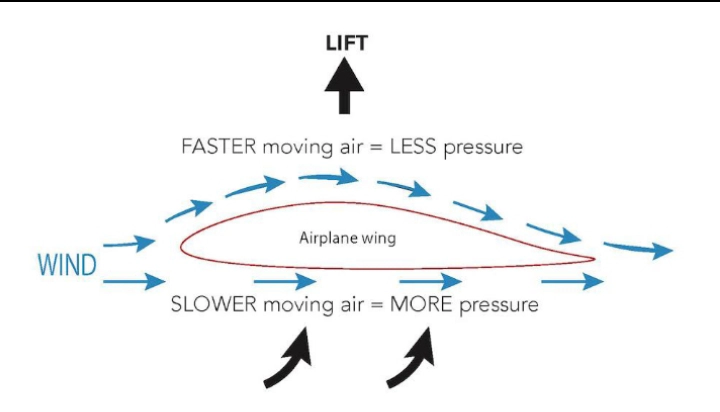
A considerable portion of aerodynamics is just understanding and optimising how air pressure acts on objects!
Conclusion:
Now, at the end of this you might be wondering why I taught you all even this, so I taught you this because you need to have a basic understanding of the laws of motion to be able to understand and grasp the concepts of aerodynamics and aerospace engineering that we are going to learn later. So let me take an example, take the second law of motion so, let us say that we are building two planes and one plane will be very heavy, while the other will be light so which one do you think will fly better? That should be easy, the light one, why? Because as we learnt earlier that lighter objects accelerate faster, hence it will be easier to fly the lighter one. Take the third law and the first law. From the first law the only thing we can learn is that nothing moves by itself there will always be a force that will change its speed, its direction or its shape and what the third law tells is that whenever we push something, it pushes us back. Do you know that literally all Jet engines, the rocket boosters, the propellers on the Planes they all work on this same principle? In the next blog I will be talking about the four forces of flight which tell us how a plane stays in the air and some common terms related to planes that you need to know. Till then!
Whenever something is taught, it is taught with a specific context, understand what that context is… And you will understand about 40% of the topic….