Flight: The Four Forces and Other Terms
- Sikander Manzoor
- Physics
- June 20, 2026
Table of Contents
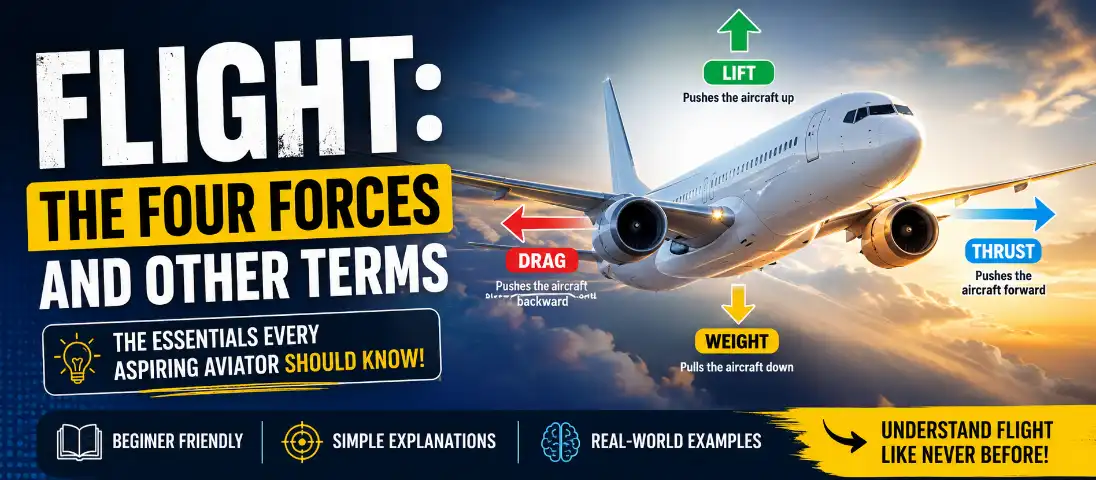
Ever wondered what keeps an airplane in the sky? Explore the four forces of flight and the basic aerospace terms that form the foundation of aviation. This beginner-friendly guide makes flight easy to understand, even if you’re starting from scratch.
*This is the 2nd blog of the series; read the first one. This was not a request, it was demand…
Introduction
Halo! You want to fly a plane? You want to soar in the air? You want to reconstruct 9/1…. Ahem… Ah yes where were we? So flying planes, what do you think, or I should say how do you think a plane flies? Just add some wings, an engine, a tail, a body, a fuel tank and a seat and plane is made… Well not so fast… My friend, if you have read the last blog you may have remembered that mass is a thing and gravity is too and let me clear this right here and right now…
- You won’t get anywhere if you brute force your plane through the air. You.. need.. AERODYNAMICS.
So lettuce begin…
Aerodynamics
Let us actually start from the start of this topic and begin with aerodynamics. What is it? Aerodynamics is the branch of science that studies how air interacts with moving objects. Or in simple terms, it is the study of how things move through the air and how the air around them affects their motion. So, now you may be wondering, why do we need aerodynamics and why doesn’t brute forcing through the air get us anywhere. The answer is pretty simple: air may be invisible, but it isn’t empty; it also has mass, it also exerts pressure, it also resists anything that tries to pass through it. Everything is resisted by air, though to a very minimal extent, but in this field, that minimal can do wonders.
You cannot simply brute-force your way through the air because the faster an object moves, the more strongly the air pushes back. If we ignored aerodynamics and relied only on powerful engines, aircraft would waste enormous amounts of energy fighting the air and might not even be able to fly efficiently. Now why do we need efficiency? Because my guy.. money and cost is a thing, even if you use powerful engines, you will be able fly, but it will be extremely dangerous like the thing would probably roll around, wouldn’t stay in the air for long and would be extremely hard to control AND the engine would cost a fortune and don’t go telling me that “how much could it even cost?”. It would probably cost a few million dollars depending on its power and also the other parts aren’t cheap either. So we use aerodynamics to our advantage, so that even with the weakest engines you can fly even better. To understand how aircraft fly efficiently, we must first understand the four fundamental forces that act on every flying machine.
The four forces
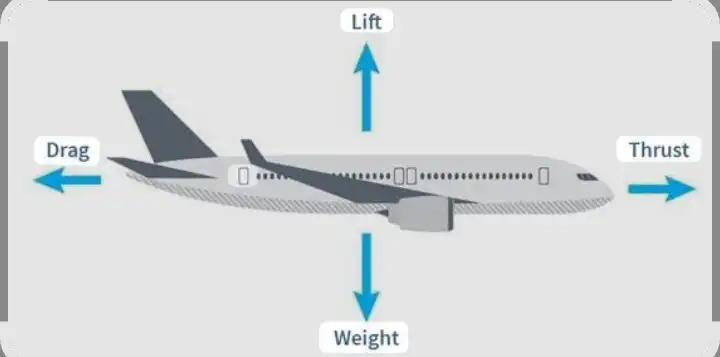
There are four forces that affect every flying machine from a paper airplane to a giant airliner. These forces also determine how an aircraft flies and whether it will climb, descend, accelerate or decelerate.
Lift
Lift is the force that pushes an aircraft upward and opposes its weight. It is generated mainly by the wings as air flows around them. Without lift, an aircraft would simply fall toward the ground due to gravity. It is basically the main force that helps an aircraft climb (climbing means ascending or going up). Now why does lift exist? Why do planes go up at certain speeds? When an aircraft is moving, air passes around the wings. The wings of an aircraft are curved in such a way that when air passes above it, it goes faster resulting in less pressure and when air passes below it, it goes slower resulting in more pressure and if you didn’t know, fluids move from higher pressure to lower pressure, but the wings in the way, so in an effort to reach lower pressure, it pushes the wing up and the plane generates lift.
Weight
Weight is the downward force exerted by gravity on the aircraft. Everything with mass experiences gravity, and aircraft are not really an exception. For an aircraft to remain in flight, lift must balance its weight and overcome it.
Thrust
Thrust is the force that propels an aircraft forward. It is produced by engines, whether they are propellers, jet engines, or rocket engines. Thrust provides the aircraft with the speed necessary for the wings to generate lift. The thrust doesn’t make the plane fly, the lift does, however thrust is needed to generate lift.
Drag
Drag is the force that opposes motion through the air. It acts in the direction opposite to thrust and tends to slow the aircraft down. As an aircraft moves faster, the effects of drag become more significant. This is why aircraft are designed with streamlined shapes—to reduce drag and improve efficiency. A streamlined shape is thin at the front and fat in the middle and smooth, to force air around it, like just imagine a plane. You get it. Drag exists because air also has mass just like water when you move your hand through it, it doesn’t go as fast as in air, the force slowing you hand down in some sort is drag, similarly our atmosphere is just a sea of….. Air and we are in, but air isn’t too dense sooo.. the drag isn’t as bad as water, but DO…. NOT…. IGNORE… IT….
These four forces are constantly interacting with one another. In straight and level flight, lift balances weight, while thrust balances drag. When this balance changes, the aircraft responds accordingly. If lift becomes greater than weight, the aircraft climbs. If thrust exceeds drag, the aircraft accelerates. Oh.. and also you wouldn’t want to see the other two cases live when you will be in the plane. You get the idea
Some other terms
So now, I will be telling you some terms which can be confusing later on and I wouldn’t want to waste words on these things over and over again, hence I will just.. Explain them now!
Control of an aircraft
Pitch: The upward or downward rotation of an aircraft. When the nose rises, the aircraft pitches up; when it lowers, the aircraft pitches down.
Roll: The rotation of an aircraft about its length. Rolling causes one wing to rise while the other drops and is used to make turns.
Yaw: The side-to-side rotation of an aircraft. During yaw, the nose of the aircraft moves left or right.
Altitude: The height of an aircraft above a reference level, usually means sea level.
Airspeed: The speed of an aircraft relative to the surrounding air. It’s different from speed because the speed of wind can affect flight.
Angle of Attack: The angle between a wing and the incoming airflow. It has a major effect on the amount of lift and drag produced. More angle of attack means lesser speed, but more lift… Till a certain point.
Aircraft design
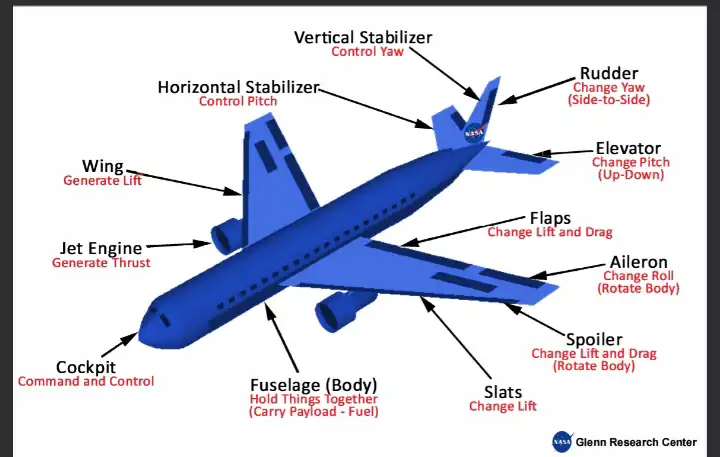
Fuselage: The main body of an aircraft, to which the wings, tail, engines, and landing gear are attached.
Wingspan: The distance from one wingtip to the other. It is one of the most important dimensions of an aircraft.
Leading Edge: The front edge of a wing that first meets the airflow.
Trailing Edge: The rear edge of a wing where the airflow leaves the wing.
Chord: An imaginary straight line joining the leading edge and trailing edge of a wing.
Wing Root: The part of the wing attached to the fuselage.
Wingtip: The outermost end of a wing.
Empennage: The tail assembly of an aircraft, consisting of surfaces that provide stability and control.
Horizontal Stabilizer: A small wing-like surface near the tail that helps maintain pitch stability.
Vertical Stabilizer: The fin-like surface on the tail that helps prevent unwanted yawing motion.
Control Surface: A movable surface used to control the aircraft’s motion. E.g. ailerons, elevators, and rudders.
Flight and navigation
Takeoff: The phase of flight in which an aircraft leaves the ground and becomes airborne.
Landing: The phase of flight in which an aircraft returns safely to the ground.
Cruise: The stage of flight during which an aircraft travels steadily at a nearly constant speed and altitude.
Climb: The process of gaining altitude after takeoff or during flight.
Descent: The process of losing altitude in preparation for landing or due to other flight requirements.
Glide: The motion of an aircraft through the air without engine power.
Range: The maximum distance an aircraft can travel without refueling.
Ceiling: The maximum altitude at which an aircraft can operate effectively.
Maneuver: Any intentional change in the speed, altitude, or direction of an aircraft.
Banking: Tilting an aircraft sideways to make a turn.
Heading: The direction in which the nose of the aircraft is pointed.
So, folks! There ain’t much we can do about these words, but keep them in mind, so… Do it… It will be helpful for the later blogs.
Conclusion
That’s it for today it was enough. If anything was confusing, tell me in the comments. I’ll see to it. I’m pretty tired y’know… been getting tons of homework and it wasn’t pleasant. In the next blog I will be talking about drag, lift and air as a fluid in detail, along with bernoulli’s principle and some other things. Till then!
Grasping terminology can cause a heck of a difference.