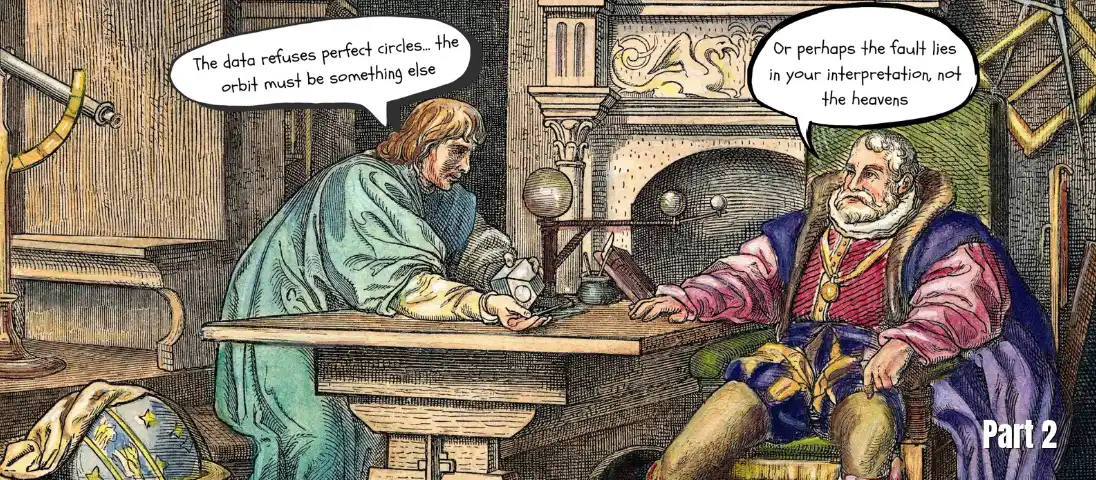
The Copernican Revolution Part 2: Kepler Fixes The Heavens
Table of Contents
Part 2 explores Tycho Brahe’s remarkably precise observations and Johannes Kepler’s groundbreaking laws of planetary motion. Together, their work transformed Copernicus’s heliocentric idea into a powerful, evidence-based model that reshaped astronomy and modern scientific thinking.
So, in the previous blog we discussed how our understanding of the cosmos changed, from the widely accepted geocentric model, to Copernicus’ heliocentric idea, and then to Tycho Brahe’s geo-heliocentric mode. In this blog we’ll discuss the questions we left unanswered in part 1. So… if you haven’t read part 1 yet, then.. go read! and don’t you dare try to reverse engineer this one.. =)
Kepler’s Breakthrough
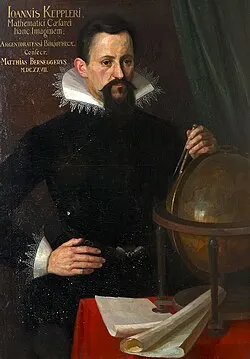
Johannes Kepler was a German astronomer and mathematician, who basically was one of the key figures in the scientific revolution. However his journey into understanding the cosmos were closely connected to Tycho Brahe.
In 1600, Kepler joined Tycho (who was then considered one of the greatest observational astronomers of his time). Tycho had spent decades carefully recording the positions of planets with great precision, whereas Kepler had a different strength: a mathematical mind and a deep curiosity to understand what these observations were actually revealing about the universe.
Well, they didn’t get along very well… but together, they had exactly what was needed to make a breakthrough. Tycho had the best data and kepler knew how to understand it.
So after tycho’s death, kepler inherited access to Tycho’s collection of observations. And these records would become the foundation for kepler’s groundbreaking discoveries about the true motion of planets!!
The Problem With Perfect Circles
Kepler initially believed in Copernicus and also in perfect circles. So, his initial goal was to fit tycho’s data into circular heliocentric orbits. To test this, kepler focused mainly on Mars because its motion appeared the most irregular compared to other planets. So, if he could accurately explain the motion of mars, the same model would work for all planets. But.. this failed. WHY?
Basically, while fitting mars’ orbit, circular model missed observations by 8 arc-minutes (means 8/60 of a degree. Since 1 degree = 60 arc minutes, this is a very tiny angle ≈ 0.13°). Tycho’s observations were extremely precise, accurate to about 1 arc minute. So, this was about 8x larger than observational error. Kepler made a critical decision: “these 8 arc minutes cannot be ignored.” He then tested perfect circles, epicycles and eccentric circles, but all failed to match the data consistently. So he concluded that the model was wrong, not data.
After years of trial to find the curve that fits the data, kepler tested: an ellipse and sun placed at one focus. This was a BREAKTHROUGH!
What exactly is an ellipse?
It simply is a set of all points such that the sum of distances to the two fixed points is constant, and these two fixed points are called Foci.
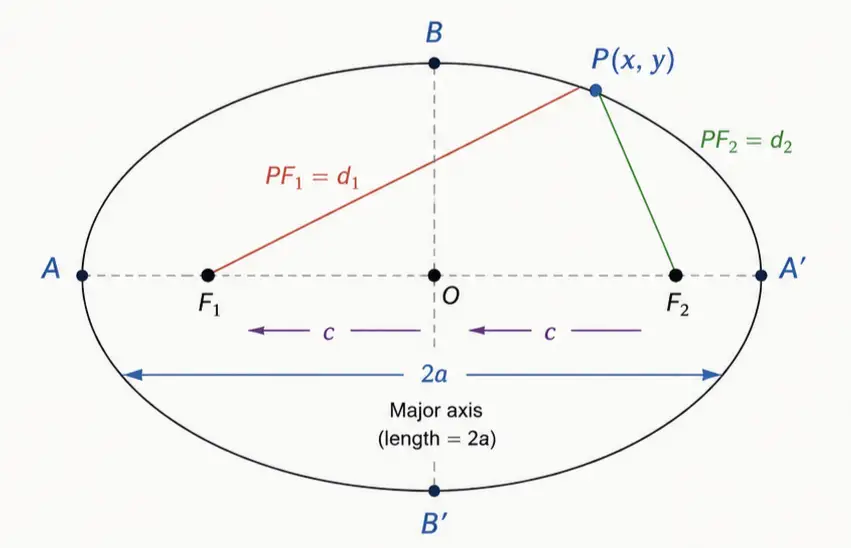
Let’s breakdown this diagram and understand what exactly an ellipse is. First of all, we are given the two Foci as F1 and F2. And from a point on the curve, P(x, y) the distance from F1 to point P is say** d1**, and distance to F2 is d2.
Now, there sum PF1 + PF2 = constant.** It simply means that the sum of the distances from any point on the curve to the two foci always remains the same. To make this clearer, take any other point on the curve say Q, and its distance to F1 is d3, and to F2 is d4. So, by saying the sum of distances to the two fixed points is constant, we mean: QF1 + QF2 = constant. Or in other words, it means the sum we get while adding the distances from P to the two Foci and from Q to the foci are SAME always!
The constant is defined as 2a (which actually is the length of the major axis) => PF1 + PF2 = constant = 2a. So, automatically QF1 + QF2 = 2a, and therefore, PF1 + PF2 = QF1 + QF2 = constant = 2a. This shows that the sum of distances from any point on the ellipse to the two foci remains the same, and this constant value (2a) defines the ellipse.
The ellipse consists of a Major and a Minor axis, here, the major axis is AA’ whose length = 2a and minor axis = BB’ = 2b.
And surprisingly enough, when the foci overlap, we get a circle! so circle basically a special case of ellipse when foci coincide. When foci coincide, F1 = F2 = center, so PF1 = r & PF2 = r, now:
PF1 + PF2 = r + r = 2r But we know: PF1 + PF2 = constant = 2a So: 2r = 2a => r = a
It simply means, when the foci of an ellipse coincide, the sum of distances becomes 2r, which equals the constant 2a. Hence, r = a, and the ellipse becomes a circle of radius a.
Kepler’s Elliptical Fix
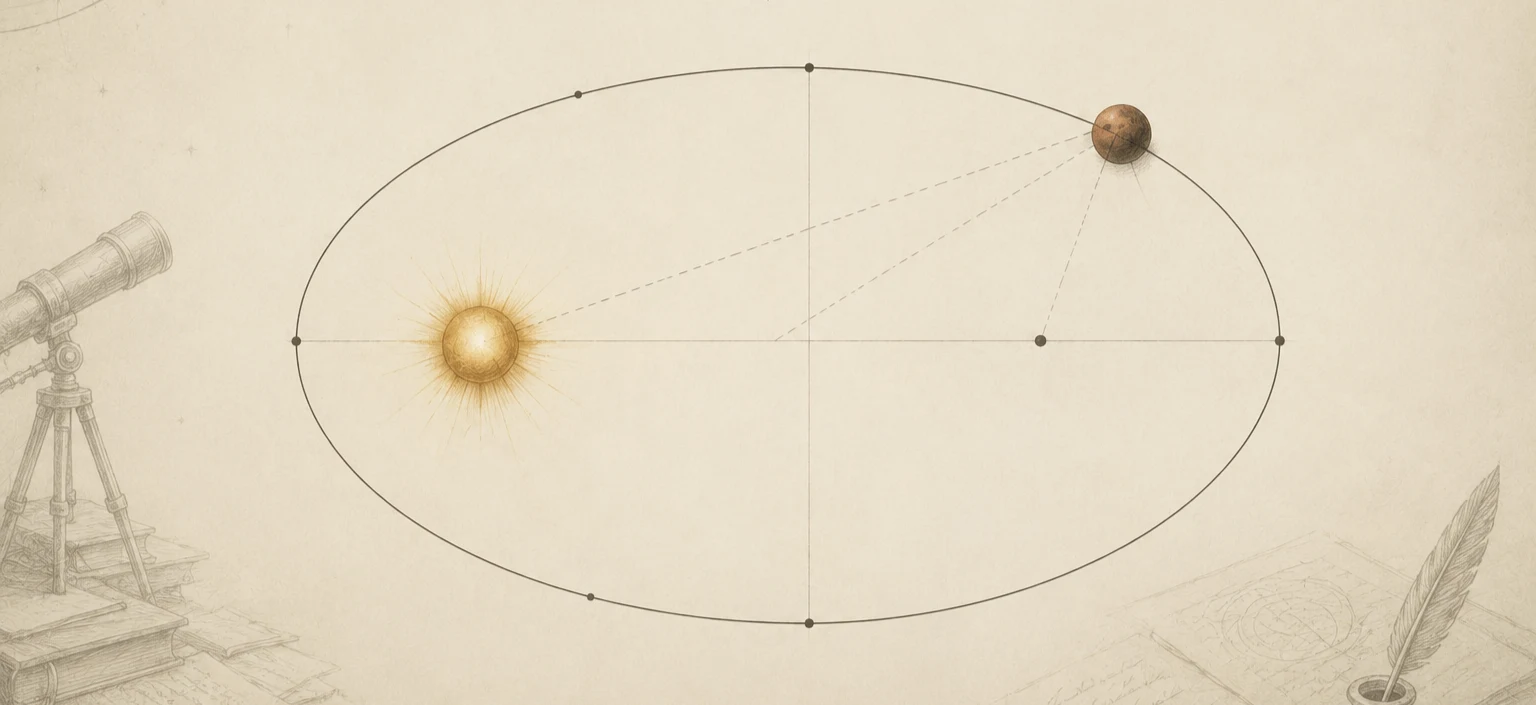
When kepler replaced circular orbit with an elliptical orbit and sun at one focus, immediately, the predicted position of mars matched tycho’s data everywhere, there was no error!
After the elliptical orbt worked, kepler generalized the pattern and formulated 3 laws:
i) Law of Ellipses ii) Law of Equal Areas iii) Law of periods (Harmonic Law)
We will discuss these laws deeply in the part 3! hope you enjoyed reading this one, stay tuned, and yeah, bye bye!