Lift and Drag: Why?
- Sikander Manzoor
- Physics
- June 27, 2026
Table of Contents
Aircraft do not defeat the air—they cooperate with it. In this blog, we explore how lift is generated, why drag exists, how angle of attack changes flight, and why understanding air itself is the key to understanding aviation.
*This is the 3rd blog of the series, so read the previous blogs, or I will feed… You to the abyss
Introduction
Arigato kozaimas.. oh wait that means thank you my bad… Konichiwa.. hmm that doesn’t sound manly enough… screw it.. Yo, whats up? I’m back for.. what was I back for?… Hmm.. engineers?.. no.. planes..NO TERRORI.. Ahem…… What I meant was planes.. yes! let’s just sighs. In the previous blogs, we learned about the four forces of flight: lift, weight, thrust, and drag. Today, we finally answer the question everyone eventually asks:
“Alright, but where does lift actually come from?”
I have answered this question 2 times already, but I have only told you that pressure difference creates lift, now you do not know why that pressure difference is and that is WHY I am here.
So, lettuce begin.
Air is a Fluid
Most people think of fluids as liquids. Water is a fluid. Oil is a fluid. Honey is a fluid if you’re patient enough, but air is also a fluid. A fluid is simply something that can flow and take the shape of its container and air does exactly that. You just don’t see it. It flows around buildings. It flows around cars. It flows around your hand when you stick it out of a car window despite your parents specifically telling you not to; and because air is a fluid, it behaves according to the laws of fluid dynamics which is a fancy name for the subject “moving fluids, the forces moving them and objects interacting with them”.This is very important because aircraft do not fly through empty space, they fly through an ocean of air.
Lift
Lift is the upward force that opposes the aircraft’s weight, but lift is not magic. The aircraft is not “floating.” And I say this.. FOR THE 3RD TIME. The air is actually pushing on it, now the real question is:
“Why does the air push upward more than it pushes downward?”
Bernoulli’s Principle
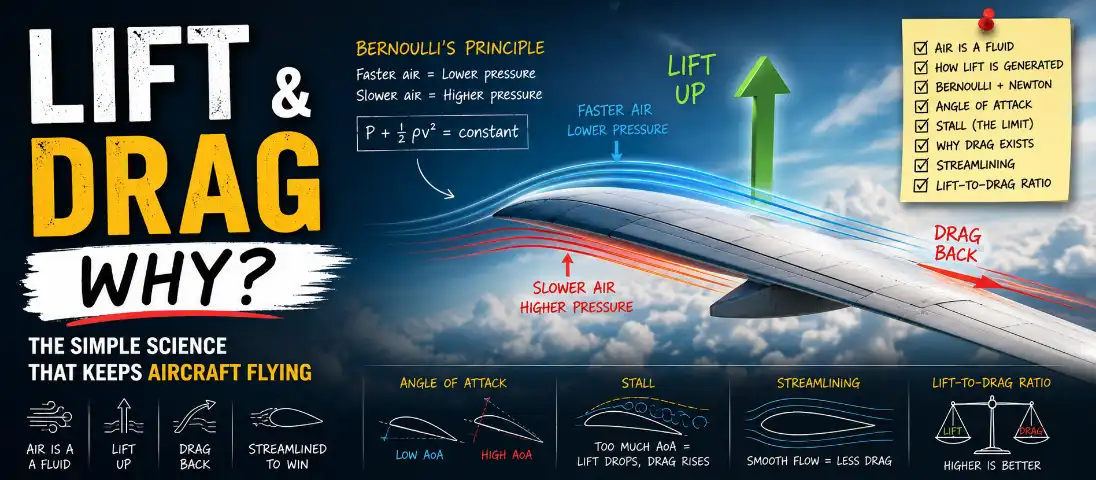
Now I know Bernoulli’s principle sounds complicated like “ohohoho, big-big physics”, but it’s really simple… The bernoulli’s principle just says that the faster a fluid moves, the lower the pressure it exerts. Similarly, slower moving fluids exert higher pressure. now I would recount the equation, but that would only complicate things. So, yeah and as I have explained earlier wings are made so that the upper side is faster and the lower side is slower and since air or any fluid would prefer going from lower to higher pressure AKA up pushing the wing upwards and generating a force called lift. Congrats! you just discovered, I award you with access to the rest of my blog.
Bernoulli’s Principle and Newton’s Third Law of Motion
Wait bucko! Bernoulli’s principle is only half the story. The wing also pushes air downward and according to Newton’s Third Law:
For every action, there is an equal and opposite reaction.
If the wing pushes air downward, the air pushes the wing upward. Simple. No negotiations. No paperwork. Newton made sure the universe handles the transaction automatically. Modern aerodynamics uses both ideas together. Pressure differences create lift. Deflecting air downward also creates lift. These are not competing explanations. They are two ways of describing the same goddang thing.
Angle of Attack
The angle of attack is simply the angle between the direction of the incoming airflow and the wing. One common misconception is that the angle of attack is fixed. It is not. If the aircraft raises its nose while the airflow remains the same, the angle of attack increases. If the aircraft lowers its nose, the angle decreases.
A larger angle of attack generally creates more lift because the wing deflects more air downward and changes the pressure distribution more strongly. However, there is a limit. If you increase it too much and the airflow begins separating from the wing. The smooth airflow becomes turbulent or as I say it “upset”. Lift drops, Drag increases and your wing essentially stops behaving like a wing and starts behaving more like an expensive piece of metal trying to argue with the atmosphere.
Stall: A stall occurs when the angle of attack becomes so large that the wing can no longer generate enough lift efficiently. Contrary to popular belief, a stall is not an engine failure. It is an aerodynamic problem. And it is the same thing you just read above.
Drag
If lift is the atmosphere helping you, drag is just the atmosphere filing a formal complaint about your existence. Drag is the force that opposes motion through the air. Whenever an object moves through air, it must push air molecules out of the way. The air does not appreciate this and pushes back. That pushback is drag. The faster you move, the stronger drag becomes. This is why a bicycle feels easy to ride at 10 km/h and much harder at 40 km/h. The bicycle did not suddenly gain weight. The atmosphere simply became less cooperative.
Streamlining
Since drag is unavoidable, engineers focus on reducing it. This is where streamlining comes in. A streamlined shape allows air to flow around an object more smoothly. The less the airflow is disturbed, the less drag is produced. This is why aircraft look sleek and smooth instead of resembling flying refrigerators. But technically, a refrigerator can fly.. for a short time… A very short time.
Lift-Drag Ratio
A natural question now appears. Why not simply maximize lift? Because increasing lift often increases drag as well. To have air push you up, it still has to push you and a part of that will slow you down. Aerodynamics is rarely about maximizing one thing. You can’t focus on something like engine strength or lift only without creating more disadvantages. It is about finding the best compromise. *Compromise is trade off, you take one thing, but lose one thing; however the thing you take should have more value than what you have lost, that is a good trade off, but what is good?*When making your own plane, YOU will have to determine that depending on what your plane is for.
The lift-to-drag ratio tells us how much lift we generate for every unit of drag we produce. A higher ratio means better efficiency. Gliders have extremely high lift-to-drag ratios. Bricks do not. This is one of the reasons gliders can travel enormous distances without engines while bricks remain loyal to gravity. Basically have more lift than drag, but not too much lift or you will have to suffer TOO MUCH DRAG. Aerodynamics is not the art of defeating air. It is the art of cooperating with it. The atmosphere is not your enemy. It is simply a very strict engineer that refuses to bend the rules for anyone. The sooner we learn those rules, the sooner we can fly.
Conclusion
Now this is what I call, a good blog; not too much, not too less….. ….. .. Ah…. I don’t think I will be able to write for long as our group of authors are not staying….. Motivated. We need your support. Please try to tell your friends to read our blogs or apply for our newsletter, as maybe just, maybe we could cause a change in their lives or help them in any way, recommend this website to your friends. And we could get more authors, more content and a better experience for you all.