Part 3: Kepler’s Laws of Planetary Motion
Table of Contents
Kepler’s three laws of planetary motion explain how planets move around the Sun in elliptical orbits, vary their speed during revolution, and follow predictable orbital relationships, forming the foundation of modern astronomy, celestial mechanics, and space exploration, inspiring scientific discoveries for centuries.
Introduction
Welcome back! So.. in the previous blog we discussed about the breakthroughs made by kepler.
After resolving the mystery of planetary orbits, he then formulated 3 laws that describe how planets move around the sun. These laws asically replaced centuries old assumptions and became a cornerstone of modern astronomy! So, in this blog, we are goin to explore these fundamental laws and understand how they changed our view of the universe.
um.. are we ready to get started?!
Law 1: Law of Ellipses
This law simply states that planets move in Ellipses, with sun at one focus. So basically, an ellipse is like a stretched circle with two special points called foci and the sun is not at the center, but at one focus and this explains why a planet’s distance from sun keeps changing. The point at which the planet is closest to the Sun is called Perihelion, while the point at which it is farthest is known as Aphelion.
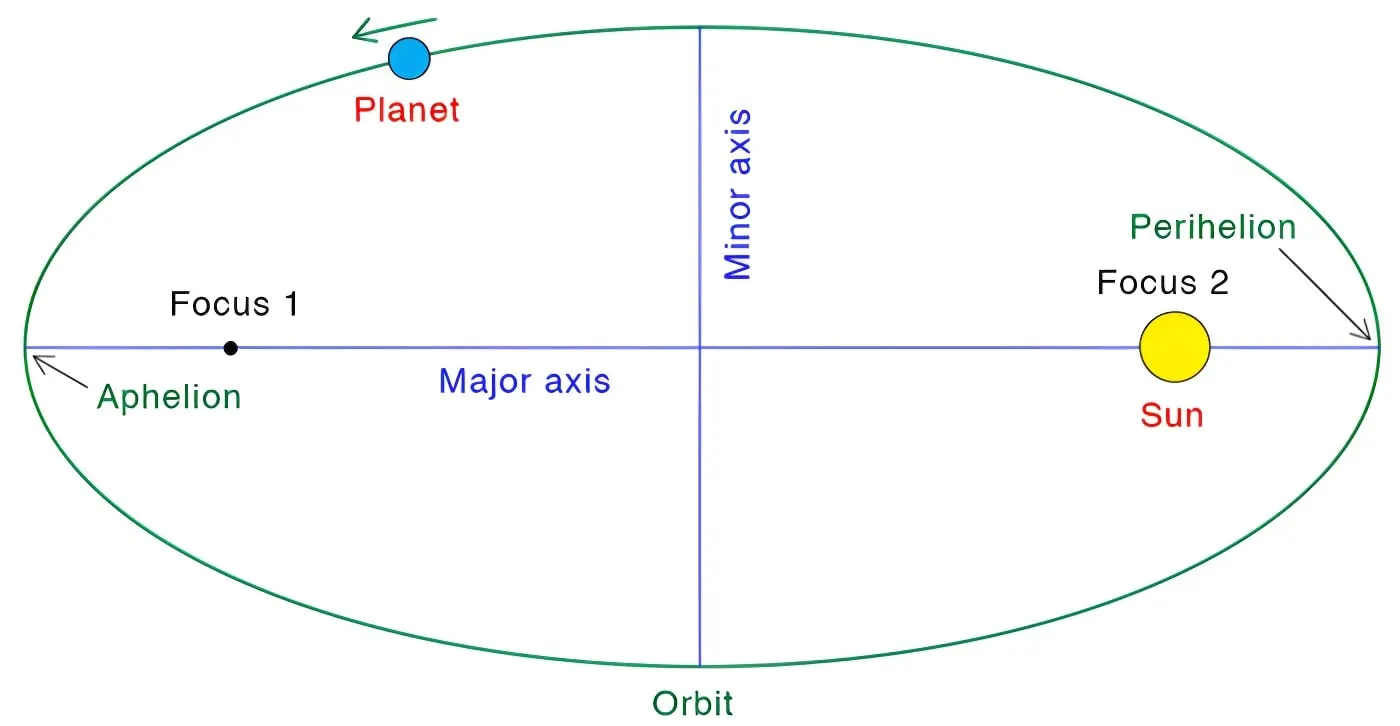
The major axis determines the maximum and minimum distances of the planet from the sun, defining perihelion + aphelion. And the minor axis indicates the width of the orbit and determines how “thick” or “flattened” the ellipse appears. But the actual sun looks at the exact center, why??
So the sun appears to be at the center of a planet’s orbit because the ellipse is only slightly stretched, in other words, it has very low eccentricity. This means the two foci are extremely close to the center, so even though the Sun lies at one focus, the difference is so small that it looks almost exactly central. So, for the sake of better explanation we often draw the ellipse more stretched than it actually is!
well…. what does eccentricity mean tho?
Firstly, eccentric means “not perfectly centered” or “off-center,” so eccentricity simply tells how off-center or stretched an orbit is. If something is not stretched at all, it means its eccentricity is 0 => perfect circle. If it’s slightly streched => almost a circle, but it eccentricity is high => oval shape.
Additionally, Eccentricity (e) = distance between center and focus ÷ semi-major axis that is, e = c / a, where c = distance from the center of the ellipse to one focus and a = semi-major axis (half of the longest diameter). It means, if e = 0 => perfect circle. If 0 < e < 1 => ellipse, and closer to 1 => oval shape. So… yeah, that’s it!
Now, earth’s orbit has a very low eccentricity (≈ 0.0167), the two Foci are very close that visually it looks like a circle but mathematically it’s an ellipse.
Law 2nd: Law of Equal Areas
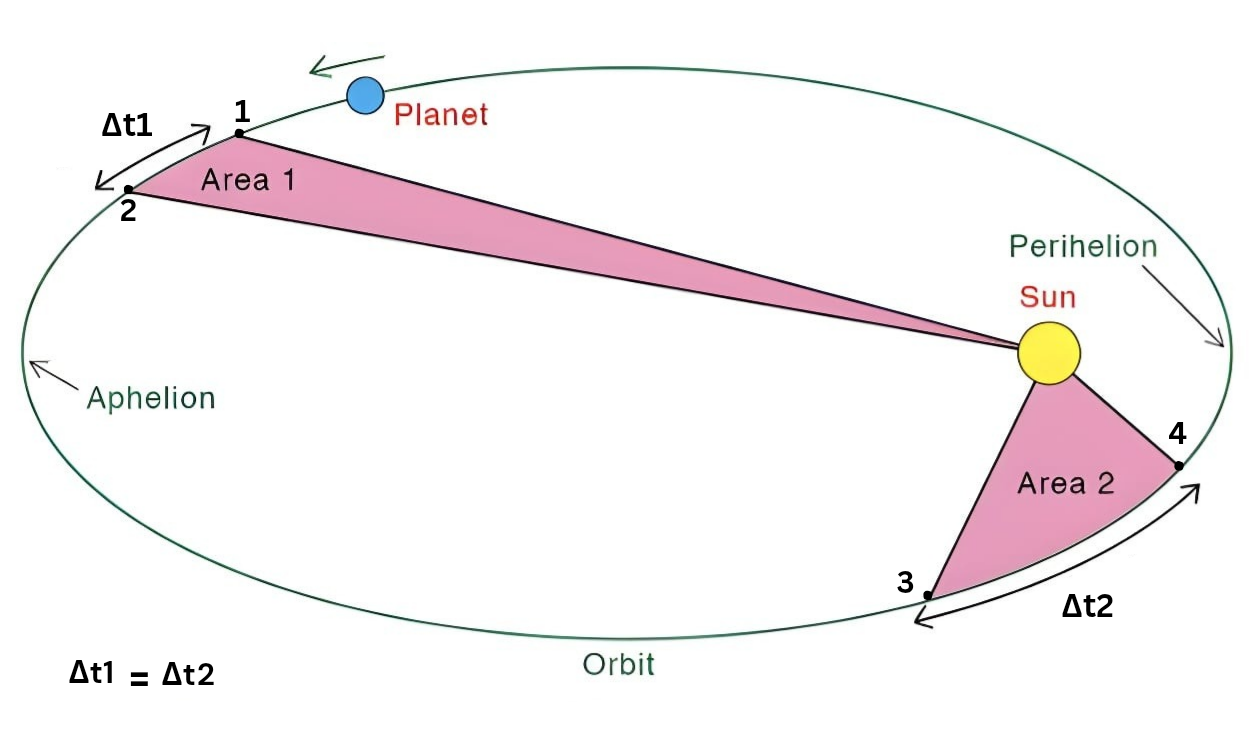
This law states that a line from the sun to a planet sweeps out equal areas in equal times. In other words, the areal velocity (tells how fast the area is swept by the line joining the planet and sun, and area swept per unit time = area swept/time) is constant. Let’s break it down:
Actually the planet doesn’t move at a constant speed, it moves faster when closer to the sun (pihelion) and moves slower when farther from the sun (aphelion). Yet in the same amount of time, the swept area is the same. So: small radius + high speed = same area & large radius + low speed = same area.
Now, let’s uderstand the figure: here, say planet changes its position from point 1 to point 2 in time Δt1 and it sweeps an area of a1. Then the planet changes its position from point 3 to 4 in Δt2 and covers an area of a2.
So, as already mentioned, law of areas states that areal velocity is constant, then, a1/*Δt1 = a2/Δt2*. Since Δt1 = Δt2, will cancel out, a1 = a2.
Law 3rd: Law of Periods / Harmonic Law
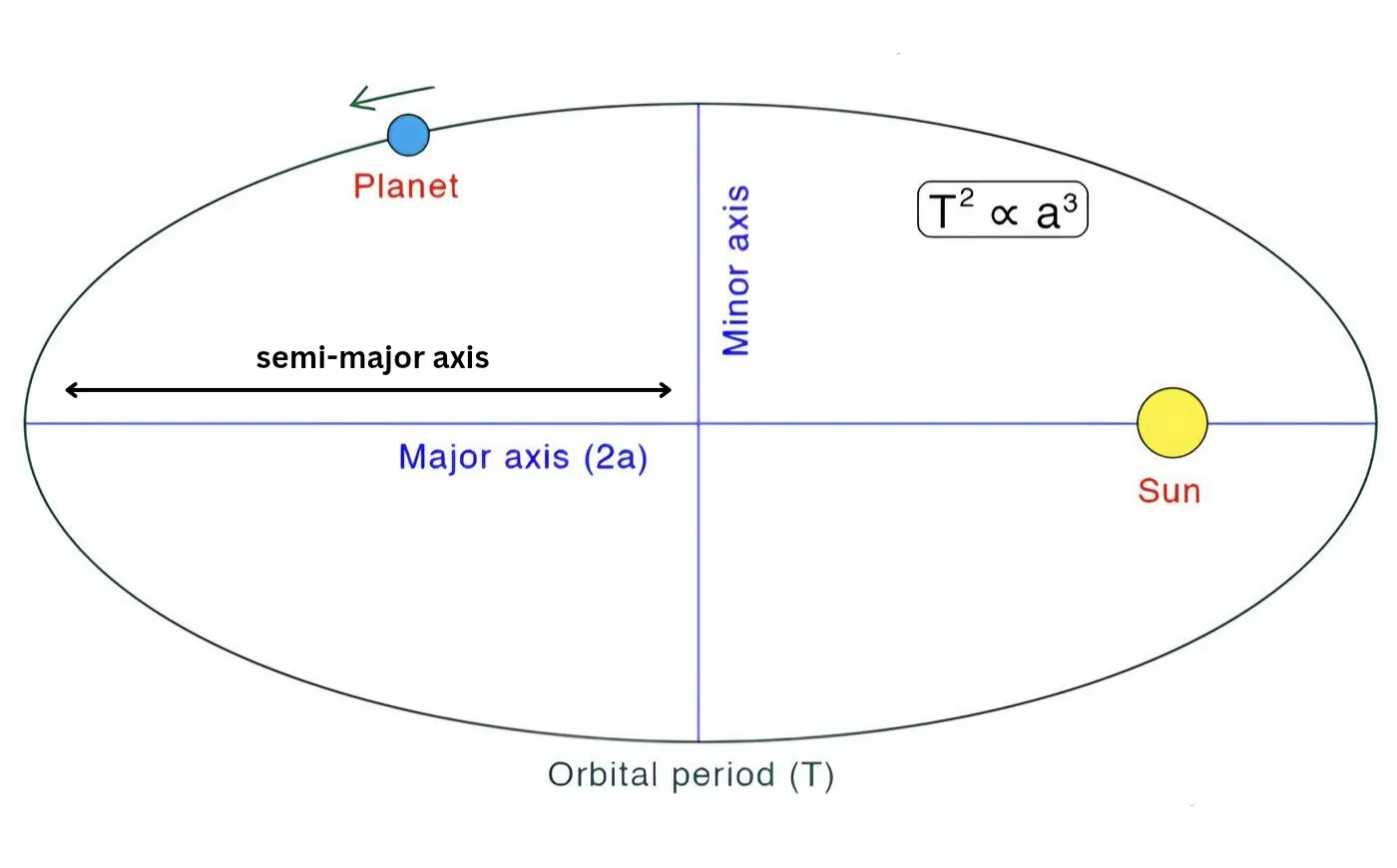
It says that the square of time period of a planet is proportional to the cube of the semi-major axis of its orbit.
it means, T² ∝ a³ or T² / a³ = constant. here, T is the time taken by a planet to complete one full orbit around the sun (or orbital period) and a is the semi-major axis of the orbit.
But what does this actually mean?
look, let’s take two planets: planet A and planet B. Now, suppose planet A has a smaller orbit so it doesn’t have to travel as far around the sun, and completes its orbit relatively quick. Meanwhile, the planet B has larger orbit, so it travels a much greater distance and it takes much longer to complete one orbit.
BUT,,, here’s what kepler dsicovered that the relation ain’t just:
T ∝ a
Instead: T² / a³ = constant. This simply means that T doesn’t increase at the same rate as a! Let’s rewrite this relationship to see how T itself changes with a:
so,
T² / a³ = k
T² = k a³
T = √(k a³)
T = √k * √(a³)
T = √k * a^(3/2)
T ∝ a^(3/2)
T² ∝ a³
This basically implies that the orbital period T increases according to the 3/2 power of the semi-major axis a. Let’s take a few examples to understand this clearly:
If a becomes 2x larger, then T = √2³= √8 ≈ 2.83x larger. If a becomes 4x larger, then T = √4³ = √64 = 8x larger… etc
So, we conclude that the orbital period isn’t linearly proportional to the size of the orbit, instead, it follows a 3/2-power relationship with the semi-major axis!
So… yeah! that’s how kepler had finally uncovered the mathematical rules governing planetary motion. But but…. there still was one big question left unanswered: WHY? Why do planets follow these paths? what keeps them moving around the sun?
To answer this, we need to go beyond describing planetary motion and ask what actually causes it, and.. this is where Isaac Newton enters the story!
well, around the same time Galileo’s observtions were further challenging the old view of the heavens.
Hope you enjoyed this one, stay tuned for part 4! bye bye!