Aircraft: Stability and Control
- Sikander Manzoor
- Physics
- July 1, 2026
Table of Contents
Aircraft don’t turn like cars, and they certainly don’t stay upright by luck. In this blog, we explore stability, control surfaces, banking, flaps, and the clever engineering that allows pilots to guide thousands of kilograms of metal through the sky with precision.
*This is the 4th blog, read the previous ones first or be bamboozled.
Introduction
Hello there! What’s up. I hope you all are doing well, cuz I am.. But not really cuz have our exams coming and it ain’t pleasant. In the previous blogs we were mainly discussing how an aircraft flies. Today we discuss how it is controlled. Yes…. stability and control, I know you have the control of of a brick falling in the influence of gravity, but in aircraft it is important to know. So lettuce begin.
Why Aircraft Don’t Simply Flip Over?
If you’ve ever thrown a pencil across a room, you’ve probably noticed something interesting. It doesn’t fly straight; it tumbles, it spins and it rotates in random directions before gravity eventually wins the argument.
So why doesn’t an aircraft do the same thing? After all, an aircraft is also just an object moving through the air…… The answer is stability….
Stability
In aerospace engineering, stability simply means:
If something disturbs the aircraft slightly, does it naturally try to return to normal, or does it become even more disturbed?
Like imagine balancing a pencil vertically on your finger. A tiny disturbance causes it to fall over, this system is unstable.
Now imagine a marble sitting inside a bowl. Push it slightly and it rolls back to the center, this system is stable.
Aircraft are designed to behave much more like the marble than the pencil. Engineers spend enormous amounts of time making sure aircraft naturally resist unwanted motions and passengers generally prefer aircraft that stay upright. Airlines seem strangely attached to this idea as well.
Centre of Gravity
The centre of gravity is the area or point where the major amount of mass is concentrated. Every object has a center of gravity. This is the point where we can imagine all of its weight acting.
If the center of gravity is badly positioned, the aircraft becomes difficult or even impossible to control. Too far forward and the aircraft constantly wants to point downward. Too far backward and the aircraft becomes unstable and overly sensitive to control inputs.
A useful analogy is carrying a broom. If you hold it near its center and it feels balanced, however if you hold it near one end, controlling it suddenly becomes much more difficult. Aircraft work in much the same way.
Each Aircraft Prefers a Certain Altitude
Another important concept is that aircraft are usually designed to prefer certain flight conditions. Depending of the aircraft and its aspects, it will need a specific altitude, like an airliner can fly in mildly bad weather and even in winds are opposing the plane to some extent, but if it is a light plane or an ultra light, it will not be able to fly in those conditions and also higher altitudes generate less drag, because air is rarer there, but that also means less lift; if a gust of wind pushes the nose upward, many aircraft naturally generate forces that encourage the nose to return toward its original position. The aircraft is essentially correcting itself. Not perfectly, not instantly, But enough to avoid becoming an airborne gymnast every time the atmosphere sneezes.
The Three Axes of Motion
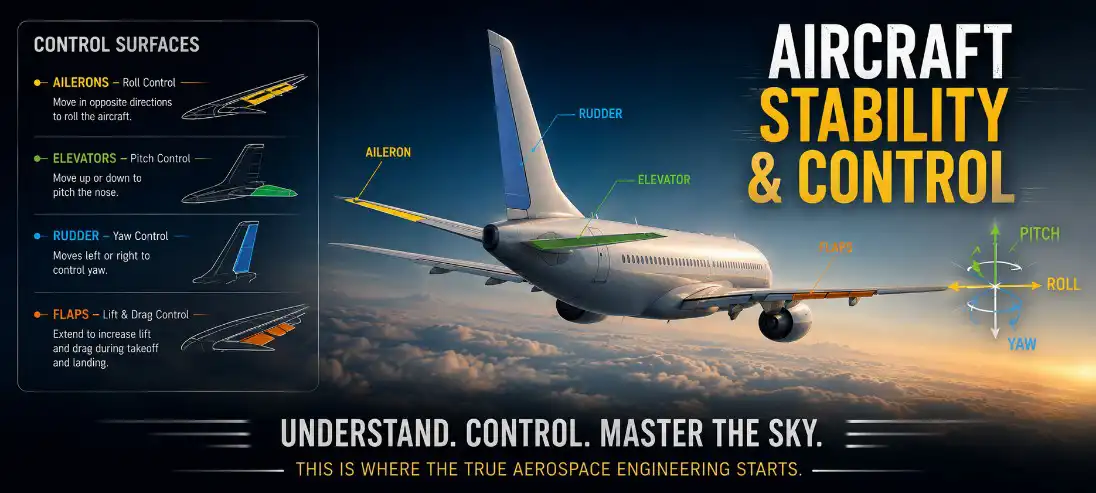
An aircraft has three axes of motion or three ways it can rotate. Aircraft do many complex maneuvers and movements and everything an aircraft does can ultimately be broken down into these three motions:
Pitch: Pitch is the up-and-down rotation of an aircraft. If the nose rises, the aircraft pitches up. If the nose lowers, the aircraft pitches down. Pitch controls climbing and descending.
Roll: Roll is the rotation around the aircraft’s length. Imagine a circle whose centre point is the nose and radius is wings, the rotation along that circle is roll. One wing rises while the other falls. Aircraft use roll to bank during turns. Banking is just rolling to make a turn.
Yaw: Yaw is the left and right movement of the nose. Imagine standing on that rotating chair and turning left or right without leaning. That is yaw. Most people expect aircraft to turn using yaw. They don’t….. At least not primarily.
Control Surfaces
Aircraft control themselves by changing how the airflow behaves around different parts of the aircraft. The movable surfaces that perform this job are called control surfaces.
Ailerons
Ailerons are located near the ends of the wings. When one aileron moves upward, the other moves downward. This changes the lift generated by each wing. One wing produces slightly more lift than the other. The aircraft rolls.
Elevators
Elevators are located on the horizontal stabilizer near the tail. Moving the elevators changes the force generated by the tail, causing the aircraft to pitch up or down.
Rudder
The rudder is attached to the vertical stabilizer. It controls yaw. Pilots use the rudder to keep turns coordinated and maintain directional control.
Contrary to popular belief, pilots do not simply point the nose toward their destination and hope for the best.
Flaps
Flaps are special surfaces located on the wings. Unlike ailerons, their purpose is not to control the aircraft’s direction. Their job is to increase lift when needed. Pilots usually deploy flaps during takeoff and landing. During takeoff, extra lift helps the aircraft leave the ground sooner. During landing, the additional drag helps slow the aircraft down while still maintaining enough lift to remain controllable. Flaps are one of the rare engineering solutions that intentionally create more drag and then celebrate doing so.
How Aircraft Actually Turn?
This is probably one of the biggest misconceptions in aviation. Cars turn by pointing their wheels in a different direction. Aircraft cannot do this. An aircraft moving at hundreds of kilometers per hour cannot simply slide sideways through the sky. The atmosphere strongly objects to that idea. Instead, aircraft turn by banking. Remember roll? This is where it becomes useful.
The pilot rolls the aircraft slightly using the ailerons. Now the lift generated by the wings no longer points perfectly upward. Part of it still points upward and supports the aircraft’s weight, But another part now points sideways. That sideways component of lift pulls the aircraft into a turn. The steeper the bank angle, the tighter the turn becomes. When moving at an angle, there are 3 components of motion; the x, y and z component or the front-back, up-down and left-right components respectively. The aircraft’s motion is also divided into these components. When going straight forward only x, and y act, but when banking, all of them act together.
The rudder assists the turn and keeps the aircraft coordinated, but it is not the primary turning mechanism. The wings do most of the work. The aircraft is not steering through the air. It is leaning into the turn and allowing lift itself to bend the flight path. Birds do exactly the same thing. Nature figured this out millions of years before humanity did. As usual, evolution got a considerable head start.
Trim
Now this is the final topic of this blog. Let me explain this using an analogy. Imagine driving a car for six hours while constantly holding the steering wheel five degrees to the left. Your arm would quickly become unhappy with you. Aircraft face a similar problem.
Depending on speed, altitude, fuel load, and configuration, pilots may need to hold continuous pressure on the controls. Trim systems solve this problem. Trim allows pilots to adjust the aircraft so that it naturally maintains its current attitude without requiring constant control input.
Instead of fighting the aircraft for hours, the pilot tells the aircraft:
“Please keep doing exactly what you’re doing.”
The aircraft, being a highly sophisticated machine worth millions of dollars, usually agrees.
Conclusion
Man… That was long and complicated (but not complicated when I’m here) and let me just tell you this. They teach this stuff in the first semester in the pilot institute. I mean they teach more, but still it is a part of that, now before my evil mind decides to cook you more. See ya!
Don’t reveal all your tactics in one blog, you moron
-Sun Tzu